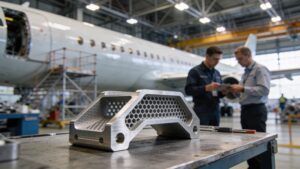
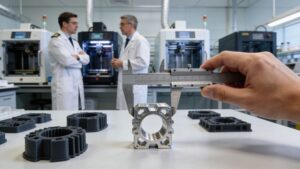
Aerospace and defense are where 3D printing stops being a hobby and becomes a mission-critical tool—turning digital designs into lightweight components, rapid prototypes, and specialized hardware built for extreme environments. On this corner of 3D Printing Street, you’ll explore how additive manufacturing supports flight-ready innovation without the long lead times of traditional machining. From aerodynamic ducting and bracketry to tooling, jigs, fixtures, and complex internal channels that reduce weight while boosting performance, the potential is massive. But so are the standards. These articles dig into high-performance polymers and metal printing concepts, qualification mindsets, repeatability, and the real-world decisions that separate “cool print” from “trusted part.” You’ll also learn how engineers use lattice structures, topology optimization, and smart support strategies to push strength-to-weight ratios into new territory. We’ll keep the focus practical and educational—highlighting processes, material selection, inspection basics, and where additive shines in aerospace and defense supply chains. If you love precision, performance, and next-level manufacturing, this is your runway.
A: Yes in some cases, but it depends on strict qualification, inspection, and application requirements.
A: Complex geometry + rapid iteration + reduced lead time—especially for tooling and specialized components.
A: Traceability and repeatability build confidence—critical when performance and safety matter.
A: Absolutely—especially for ducting, brackets, housings, and tooling when heat and load limits are respected.
A: They can reduce mass while maintaining stiffness and strength where it’s needed.
A: Start with tooling, fixtures, fit-check models, and educational test structures.
A: Consistent process control, validated material behavior, and inspection-driven confidence.
A: Optimize orientation, add walls/ribs, use fillets, and tune bonding with stable temps.
A: Weak layer bonding or stress concentrators near supports, seams, and sharp corners.
A: Rapid spares, tooling, low-volume specialty parts, and prototyping that shortens development cycles.