Aerospace Didn’t Just Adopt 3D Printing—It Needed It
Aerospace manufacturing has always lived at the edge of what’s possible. The industry asks materials to endure brutal temperature swings, vibration that never stops, pressure changes that repeat for decades, and load cycles that punish the smallest imperfection. It also asks engineers to build systems that are lighter every year, more efficient every decade, and more reliable always. That combination creates a constant tension: bold designs meet the stubborn realities of fabrication. 3D printing—additive manufacturing—entered this world with a different philosophy. Instead of cutting shapes out of billets or carving parts from castings, it builds components layer by layer directly from a digital model. At first it looked like a prototyping trick. Then it became a tooling shortcut. Now it’s increasingly a production strategy, not because aerospace loves novelty, but because additive manufacturing solves problems that traditional methods struggle to solve at the same speed, cost, or complexity. The transformation is happening in multiple directions at once. It’s changing what parts look like, how fast they can be designed, where they can be produced, and how supply chains are managed. And the most important shift may be the quietest: aerospace is learning to design for additive manufacturing instead of forcing additive manufacturing to imitate machining.
A: Brackets, ducting, housings, heat exchangers, tooling, and select high-value metal components.
A: It enables topology optimization and lattice structures that remove unnecessary material.
A: They can be, when produced under controlled processes and qualified through testing and inspection.
A: Not entirely—many printed parts still need machining for final tolerances and surfaces.
A: Equipment, materials, post-processing, inspection, and certification requirements.
A: Engineers can prototype and iterate designs faster without new tooling.
A: Combining multiple components into one printed part to reduce assembly steps and failure points.
A: Digital part libraries enable printing at qualified sites to reduce lead times and disruptions.
A: Titanium, aluminum alloys, nickel alloys, and high-performance aerospace polymers.
A: More certified production parts, more automation, and wider adoption across platforms.
What “Aerospace 3D Printing” Actually Means
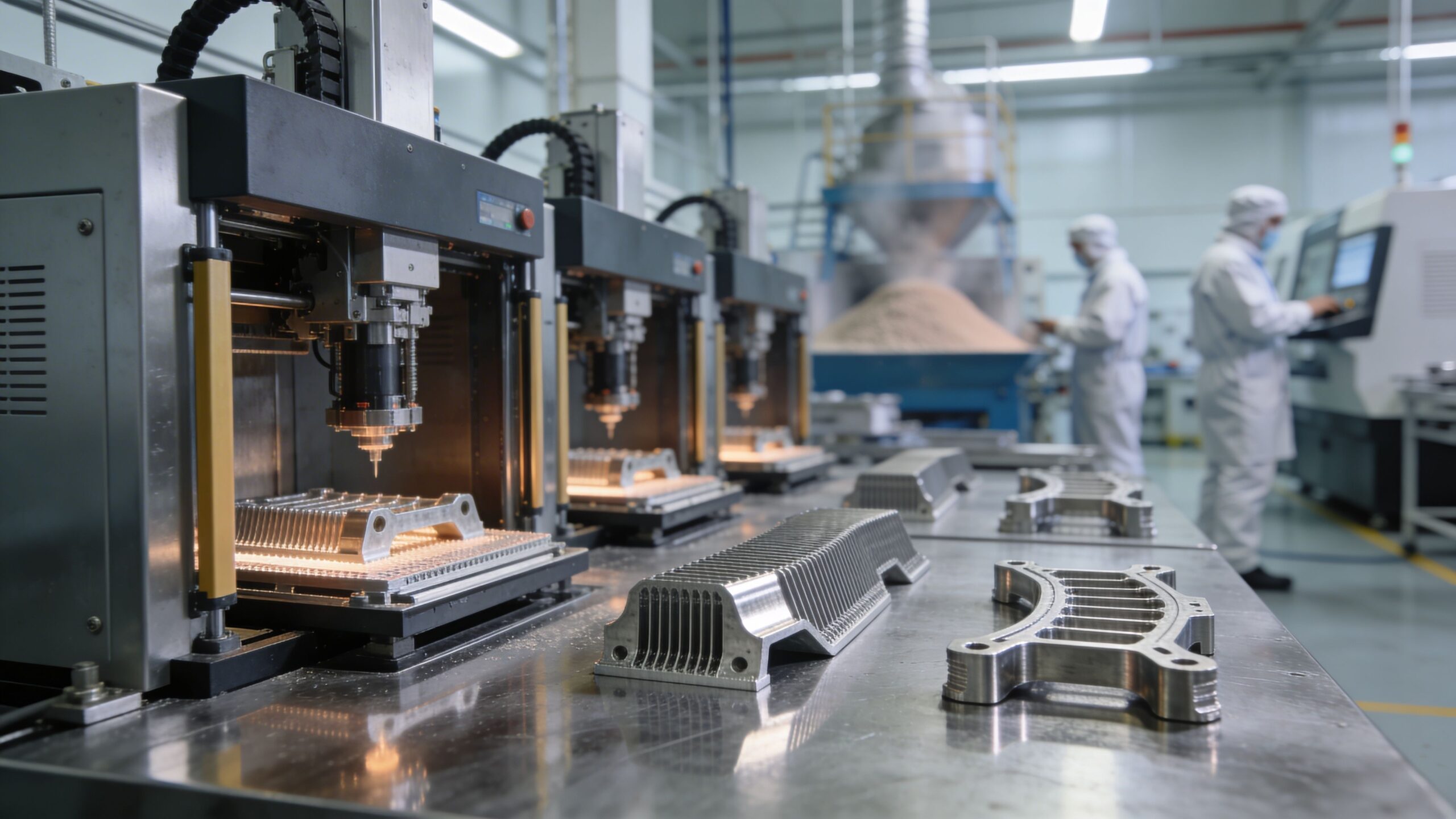
When people think of 3D printing, they often picture desktop machines laying down plastic filament. Aerospace lives in a different universe. The printers are industrial systems with controlled atmospheres and high-powered energy sources. The materials are aerospace alloys and high-performance polymers engineered to handle heat, stress, and fatigue. The quality systems are built around traceability, repeatability, and inspection practices that can verify what the eye can’t see.
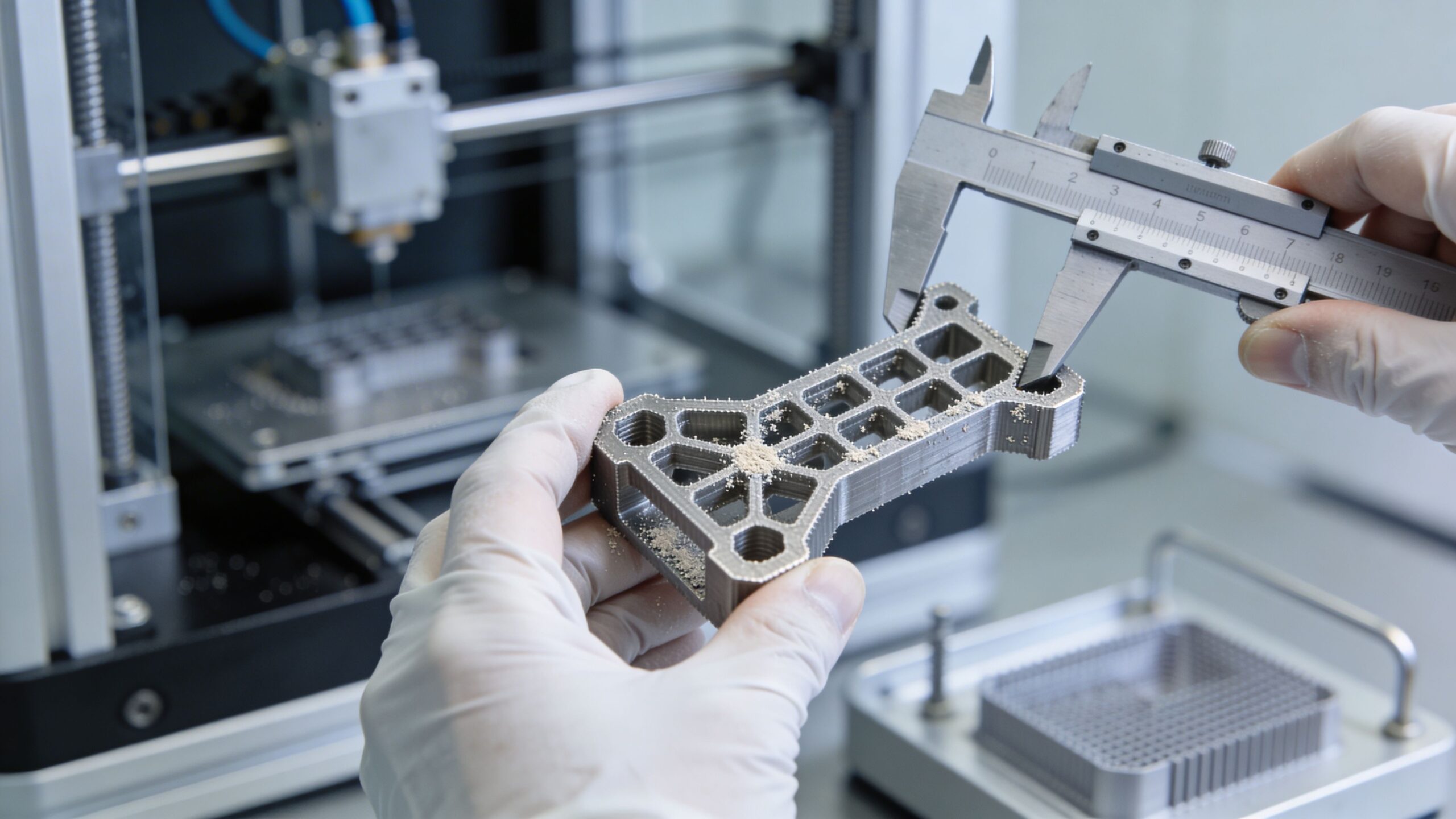
Many aerospace metal parts are produced using powder-based processes that fuse thin layers with a laser or electron beam. Polymer parts might use advanced processes designed for strong, lightweight components. In both cases, printing is only one stage of manufacturing. Post-processing—heat treatment, stress relief, machining of critical interfaces, surface finishing, and non-destructive inspection—is often essential.
So the transformation isn’t simply “printing instead of machining.” It’s the creation of an end-to-end additive manufacturing pipeline that blends digital engineering, controlled production, and rigorous verification into a system aerospace can trust.
The Big Breakthrough: Complexity Stops Being a Problem
Traditional manufacturing rewards simplicity. Straight bores, flat mating surfaces, uniform thickness, and easily accessible features keep machining efficient and predictable. Aerospace engineers, however, rarely want simple. They want optimized. They want airflow that curves through constrained spaces. They want cooling that reaches the hottest regions of an engine component. They want strength where loads concentrate and weight removed everywhere else.
Additive manufacturing changes the relationship between design and manufacturing. Complex internal channels, organic load-bearing structures, and integrated features become achievable in a single build. Instead of assembling multiple parts to create a complex system, engineers can build the complexity into one component. This matters because aerospace is full of hidden “taxes” caused by complexity: extra fasteners, extra welds, extra inspection steps, extra supply chain dependencies. When 3D printing allows complexity without assembly, it reduces those taxes. That is one reason additive manufacturing is transforming aerospace manufacturing at a structural level.
Weight Reduction: The One Metric That Touches Everything
In aerospace, weight is a master variable. It impacts fuel burn, payload capacity, range, climb performance, and even the stresses experienced by other components. Reducing weight in one place can allow engineers to reduce weight elsewhere, creating a compounding effect across the platform.
3D printing enables weight reduction through topology optimization and lattice structures. Topology optimization uses software to sculpt parts around actual load paths, stripping away excess material that traditional design conventions might leave in place. The resulting shapes can look “grown” rather than machined, with smooth curves and branching supports that place material only where it matters.
Lattice structures push weight reduction even further by creating internal frameworks that maintain stiffness while using far less material than solid designs. These lattices can also be tuned—thicker in high-stress regions, lighter where loads are lower—creating parts that balance strength and efficiency in ways that are difficult to achieve with conventional methods. When aerospace manufacturers adopt these strategies, they’re not just printing parts. They’re redesigning the physical logic of components to match performance goals more closely.
Part Consolidation: Less Assembly, More Reliability
A modern aircraft contains countless assemblies that exist primarily because manufacturing constraints made them necessary. If a part is too complex to manufacture in one piece, it gets split into subcomponents and assembled. Each added part introduces fasteners, joints, and interfaces that must be engineered, installed, and inspected.
Additive manufacturing enables part consolidation, where multiple components are redesigned into a single printed structure. This can reduce assembly labor and speed production, but it also improves reliability by eliminating failure points. Fewer fasteners and fewer seams often mean fewer opportunities for looseness, leaks, or fatigue cracks to develop over time. Consolidation also reduces the overhead of quality control. Instead of inspecting and tracking many pieces from many suppliers, manufacturers can focus on one qualified component produced under controlled conditions. In an industry where traceability and inspection are integral, simplifying assemblies can be a major operational advantage.
Faster Prototyping and Shorter Development Cycles
Aerospace has always been cautious, and for good reason. But caution doesn’t mean slow thinking—it often means slow fabrication. Traditional methods frequently require tooling, fixtures, and long supplier lead times before a part can be tested. That makes early-stage iteration expensive and time-consuming.
3D printing shortens the design-to-test loop. Engineers can produce prototypes quickly, evaluate fit and performance, then revise designs without waiting on new tooling. This accelerates R&D and allows more design options to be explored early, when changes are easiest to make.
The speed advantage isn’t just about prototypes. It’s also about development programs where rapid iteration can uncover better solutions faster. When engineers can test multiple variations of airflow ducts, brackets, housings, or thermal components, the final design is often more optimized. In aerospace, where small performance gains can be meaningful, the ability to iterate quickly becomes a competitive advantage.
Engines and Thermal Systems: Printing the Invisible Features
If there’s a frontier where additive manufacturing feels almost inevitable, it’s propulsion and thermal management. Engines and high-performance systems depend on precise control of heat and airflow. Many of the most valuable features are internal: cooling channels, flow paths, mixing zones, and heat exchange surfaces. Additive manufacturing can create internal geometries that conventional machining can’t. Cooling channels can follow the exact contours needed to remove heat efficiently. Heat exchangers can be printed with extremely high surface area packed into compact volumes. Components can integrate multiple flow functions into one part, reducing interfaces and improving performance.
These capabilities don’t just improve efficiency. They can also improve durability by reducing hotspots and thermal stresses. Over the lifetime of a component, that can translate into longer service intervals and improved reliability—two metrics aerospace manufacturers and operators never stop chasing.
Production Tooling and Factory Support: The Underrated Transformation
Not all aerospace 3D printing is about flight hardware. One of the most practical and widespread transformations is the use of additive manufacturing for tooling, jigs, fixtures, and assembly aids. These items don’t fly, but they help aircraft get built faster and more consistently.
3D printed tooling can be customized to specific assembly steps and produced quickly. If a production line needs a new guide, drill template, or ergonomic positioning tool, additive manufacturing can deliver it without expensive machining. This reduces downtime and helps factories adapt quickly when designs change.
Because tooling improvements can affect production efficiency across thousands of units, even small changes can have large operational impacts. In many aerospace programs, tooling and support parts are a quiet but powerful reason additive manufacturing is becoming embedded in the factory floor.
Supply Chain Resilience: Digital Inventory and Distributed Production
Aerospace supply chains are global, specialized, and often fragile. Many parts come from limited suppliers with unique capabilities. When disruptions occur, they can delay production and maintenance across entire fleets. Additive manufacturing provides a new way to think about supply chains: digital inventory.
Instead of relying exclusively on physical stock and long shipping routes, manufacturers can maintain libraries of qualified digital part files. When a part is needed, it can be produced at a qualified facility closer to demand. This can reduce lead times and lessen reliance on single-source suppliers for certain components. Distributed production doesn’t eliminate supply chain complexity, but it adds flexibility. In a world where aircraft downtime is expensive and program schedules are unforgiving, that flexibility is a major advantage. The transformation isn’t just about printed parts—it’s about printed logistics.
The Hard Part: Certification, Inspection, and Repeatability
Aerospace manufacturing is governed by trust and verification. For 3D printing to transform the industry, it must do something more difficult than producing impressive parts: it must produce consistent parts. The same geometry printed twice must behave the same way under load, fatigue, and temperature variation.
Additive manufacturing introduces variables that aerospace must control carefully. Powder quality, machine calibration, build orientation, thermal history during printing, and post-processing methods all influence final material properties. That is why aerospace additive manufacturing is tightly linked to process monitoring, standardized parameters, and extensive inspection.
Non-destructive testing is often central, especially when internal features are critical. Manufacturers may use advanced scanning methods to confirm internal geometry and detect defects. Qualification programs focus on repeatability across builds and machines, not simply on a single successful print.
This rigor is part of why the transformation takes time. But it’s also why it lasts. Once an additive process is qualified and stable, it becomes a dependable production pathway that can scale.
The Future Aerospace Factory: More Digital, More Adaptive, More Additive
3D printing is transforming aerospace manufacturing because it aligns with what aerospace needs next: lighter designs, faster development, and more resilient production systems. The technology is enabling forms that traditional manufacturing can’t easily create. It’s reducing assembly complexity through part consolidation. It’s accelerating prototyping and shortening design cycles. It’s reshaping supply chains through digital inventory and distributed production. The future aerospace factory will likely blend additive and traditional manufacturing rather than choosing one over the other. Machining will remain essential for many parts and final finishing. Casting and forging will remain important for certain structural components. But additive manufacturing will expand wherever complexity, weight savings, customization, and rapid iteration provide the greatest value.
The most important transformation may be cultural: engineers learning to design with additive manufacturing in mind from the beginning. When aerospace stops treating 3D printing as a shortcut and starts treating it as a design language, the results become more than incremental. They become structural shifts in how aircraft and spacecraft are conceived, built, and sustained. Aerospace has always been about mastering extremes. Additive manufacturing is helping it master another extreme: building precisely what’s needed, with less waste, more intelligence, and far more design freedom than the old rules allowed.