
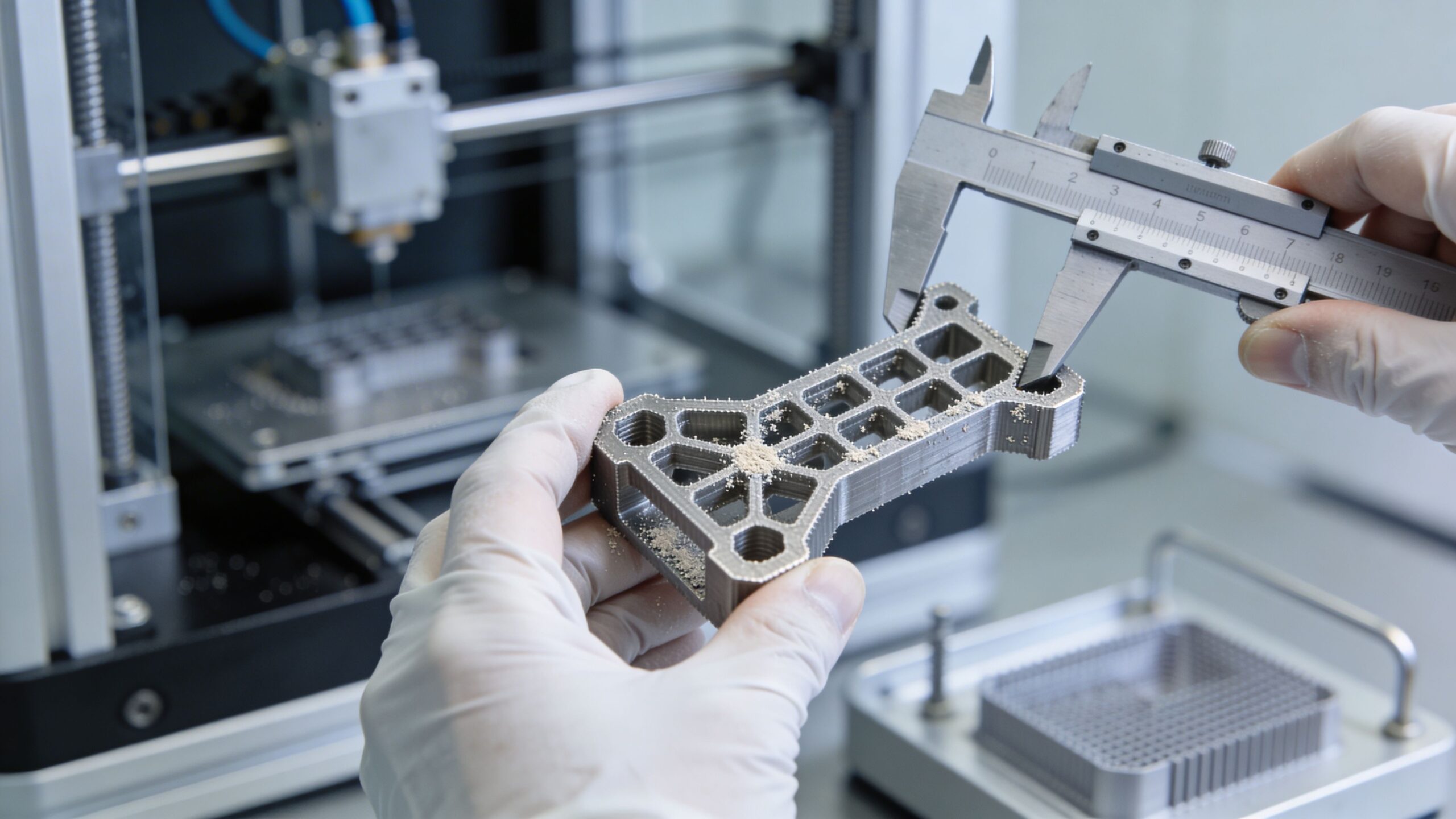
A New Era of Space Manufacturing
For decades, building spacecraft required enormous factories, complex supply chains, and years of engineering effort. Every bolt, bracket, and fuel system component had to be precisely machined, tested, and assembled using traditional manufacturing techniques. While these methods created reliable spacecraft, they were often slow, expensive, and limited in design flexibility. Today, NASA is rewriting those rules through the power of additive manufacturing. More commonly known as 3D printing, this technology allows engineers to build intricate spacecraft components layer by layer directly from digital designs. Instead of carving parts out of solid blocks of metal or assembling dozens of smaller pieces, engineers can now produce complex structures in a single print. This shift is more than just a manufacturing improvement. It represents a fundamental transformation in how spacecraft are designed, tested, and built. By embracing 3D printing, NASA can accelerate innovation, reduce costs, and unlock entirely new possibilities for space exploration.
A: Match the model, material, settings, and finish plan to the purpose of the print.
A: Bed leveling, surface cleanliness, nozzle height, temperature, and material condition are the usual suspects.
A: No. Slower speeds can improve detail, but heat buildup and profile balance still matter.
A: Use the right material, more walls, smart orientation, enough infill, and realistic load testing.
A: Temperature, retraction, travel moves, moisture, and material type all contribute.
A: Diagnose stringing, warping, weak layers, clogs, and moisture bubbles before buying parts.
A: Very important; it shows toolpaths, supports, layer changes, and possible weak spots before printing.
A: First layers, simple calibration prints, support cleanup, and basic material profiles.
A: Clean orientation, tuned settings, good material handling, and careful support removal, sanding, painting, smoothing, and part testing.
A: It is most useful for makers matching material behavior to the job instead of only the color.
What 3D Printing Means for Aerospace Engineering
At its core, 3D printing works by building objects layer by layer using materials such as metals, polymers, or advanced composites. A digital model guides the printer, which deposits or melts material precisely where it is needed. Over time, these layers form a complete part with intricate internal features that traditional manufacturing would struggle to produce.
For aerospace engineers, this capability is revolutionary. Many spacecraft components must withstand extreme conditions, including intense heat, pressure, and vibration during launch. Traditional manufacturing often forces engineers to simplify designs so they can be machined or assembled from multiple pieces.
Additive manufacturing removes many of these limitations. Engineers can now create complex internal cooling channels, lattice structures, and optimized shapes that reduce weight while maintaining strength. These innovations can improve performance, reduce fuel consumption, and increase reliability. NASA has quickly recognized these advantages and has integrated additive manufacturing into multiple programs ranging from rocket propulsion to orbital manufacturing.
3D Printed Rocket Engines
One of the most exciting applications of additive manufacturing at NASA involves rocket engines. These powerful machines contain hundreds of complex parts that must function flawlessly under extreme temperatures and pressures.
Traditionally, rocket engines required hundreds of individual components welded or bolted together. Each joint represented a potential failure point, and manufacturing the parts often took months.
With 3D printing, engineers can combine multiple components into a single integrated structure. A rocket injector or nozzle that once required dozens of parts can now be printed as one piece. This reduces weight, simplifies assembly, and improves reliability.
NASA has successfully tested several 3D printed rocket engine components, including injectors and combustion chambers. These parts have undergone rigorous hot-fire testing, proving they can withstand the harsh conditions of rocket propulsion.
By using additive manufacturing, NASA can prototype and test new engine designs far more quickly than in the past. What once required months of machining can now be produced in days.
Lightweight Spacecraft Structures
Weight is one of the most critical challenges in spaceflight. Every kilogram added to a spacecraft requires additional fuel to launch into orbit. Reducing weight while maintaining strength is therefore a top priority for aerospace engineers. 3D printing offers powerful tools for solving this challenge. Engineers can design internal lattice structures that provide strength with minimal material. These intricate patterns resemble the internal structure of bones or honeycombs, distributing stress efficiently while keeping parts lightweight.
Using advanced design software, engineers perform topology optimization to determine exactly where material is needed and where it can be removed. The resulting shapes often appear organic or futuristic, with flowing curves and hollow sections that would be impossible to machine using traditional techniques. NASA has used these methods to develop lighter brackets, structural supports, and satellite components. These improvements may seem small individually, but across an entire spacecraft they can significantly reduce launch mass and increase mission efficiency.
Manufacturing Parts in Space
Perhaps one of the most fascinating uses of 3D printing is manufacturing directly in space. NASA has already demonstrated this capability aboard the International Space Station.
In orbit, astronauts cannot simply visit a hardware store if a tool breaks or a component fails. Traditionally, spare parts had to be launched from Earth, which could take months and cost enormous amounts of money.
With a 3D printer onboard, astronauts can fabricate tools and replacement parts on demand. Engineers on Earth send digital design files to the station, and astronauts print the required items within hours.
This approach dramatically improves flexibility during missions. It also represents a crucial step toward long-duration space travel. Future missions to the Moon or Mars may rely heavily on additive manufacturing to produce tools, replacement components, and even habitat structures far from Earth.
Advanced Materials for Space Printing
The success of additive manufacturing in aerospace depends heavily on the materials used. Spacecraft components must withstand extreme environments including high temperatures, vacuum conditions, radiation exposure, and intense mechanical stress.
NASA works with a range of advanced materials designed specifically for these challenges. Metal powders such as titanium, aluminum alloys, and nickel-based superalloys are commonly used for high-strength aerospace components. These materials provide excellent heat resistance and structural durability.
For certain applications, engineers also use specialized polymers and composites. These materials can be lighter than metals while still providing sufficient strength for interior spacecraft components or satellite structures. Developing and testing these materials is a critical part of NASA’s additive manufacturing research. Each new material must undergo extensive testing to ensure it can survive the harsh conditions of space.
Faster Prototyping and Innovation
Speed is another major advantage of 3D printing. Traditional aerospace manufacturing can take months or even years to produce new components due to complex tooling and machining processes.
Additive manufacturing allows engineers to move from digital design to physical prototype much faster. A design modification can be implemented immediately and printed within hours or days.
This rapid prototyping capability enables NASA engineers to test new ideas more frequently. Designs can evolve through multiple iterations in a short time, leading to better performance and improved reliability.
Faster development cycles are particularly valuable for experimental technologies and future mission concepts. Instead of waiting for lengthy manufacturing processes, engineers can quickly build and evaluate new components.
Reducing Supply Chain Complexity
Spacecraft contain thousands of individual parts, many of which come from specialized suppliers around the world. Managing this complex supply chain can be challenging and costly. 3D printing offers a way to simplify these logistics. Many components that previously required multiple suppliers can now be produced directly in-house using additive manufacturing.
By consolidating parts and reducing assembly steps, NASA can streamline production and reduce the number of components needed. This not only saves time and money but also improves reliability by reducing potential points of failure. In future missions, digital inventories of part designs could replace physical storage. Instead of carrying thousands of spare components, astronauts could simply print what they need when they need it.
Preparing for Missions to the Moon and Mars
As NASA prepares for ambitious missions to the Moon and Mars, additive manufacturing is becoming increasingly important. These missions will require durable spacecraft, advanced habitats, and reliable equipment capable of operating far from Earth.
3D printing offers a flexible manufacturing solution for these challenges. Engineers are exploring ways to print structures using materials available on other planetary bodies. For example, lunar soil could potentially be used to create building materials for Moon bases.
This concept, known as in-situ resource utilization, could dramatically reduce the amount of material that must be launched from Earth. Instead of transporting entire structures, missions could carry compact printers and build infrastructure using local resources. While this technology is still in development, it represents an exciting vision for the future of space exploration.
The Future of Additive Manufacturing in Space
NASA’s work with additive manufacturing is still evolving. New printing technologies, materials, and design methods continue to expand what is possible in spacecraft manufacturing. Future spacecraft may contain hundreds or even thousands of 3D printed components, from structural supports to propulsion systems. Entire spacecraft sections could eventually be produced using advanced additive manufacturing techniques.
As technology advances, the ability to manufacture parts in orbit or on other planets could become a standard capability for space missions. This would dramatically increase the autonomy and resilience of future exploration programs. 3D printing is not just improving how spacecraft are built. It is helping redefine how humanity approaches space exploration itself.
Research-Backed Context
Industrial additive manufacturing is valuable when it solves a production constraint. Weight reduction, part consolidation, tooling speed, spare-part availability, customization, and shorter development cycles are stronger reasons than novelty alone.
Practical Decision Checks
- Separate prototype use from production use; production requires stronger evidence and documentation.
- Check qualification, repeatability, inspection, post-processing, and material traceability.
- Compare total cost, including machine time, finishing, failed builds, labor, and quality control.
- Look for parts where geometry, lead time, weight, or supply-chain risk gives 3D printing a real advantage.
FAQ
Why do aerospace and defense teams use 3D printing?
They use it when lighter geometry, faster tooling, replacement-part access, or complex designs create a measurable advantage.
Is every printed part production-ready?
No. Production parts need qualified materials, repeatable processes, inspection, documentation, and often post-processing.
What is the main tradeoff?
Additive manufacturing can reduce lead time and part count, but finishing, certification, and machine economics still matter.
Sources and Further Reading
These references support the technical terms, material guidance, process limits, and decision criteria used in this article.


