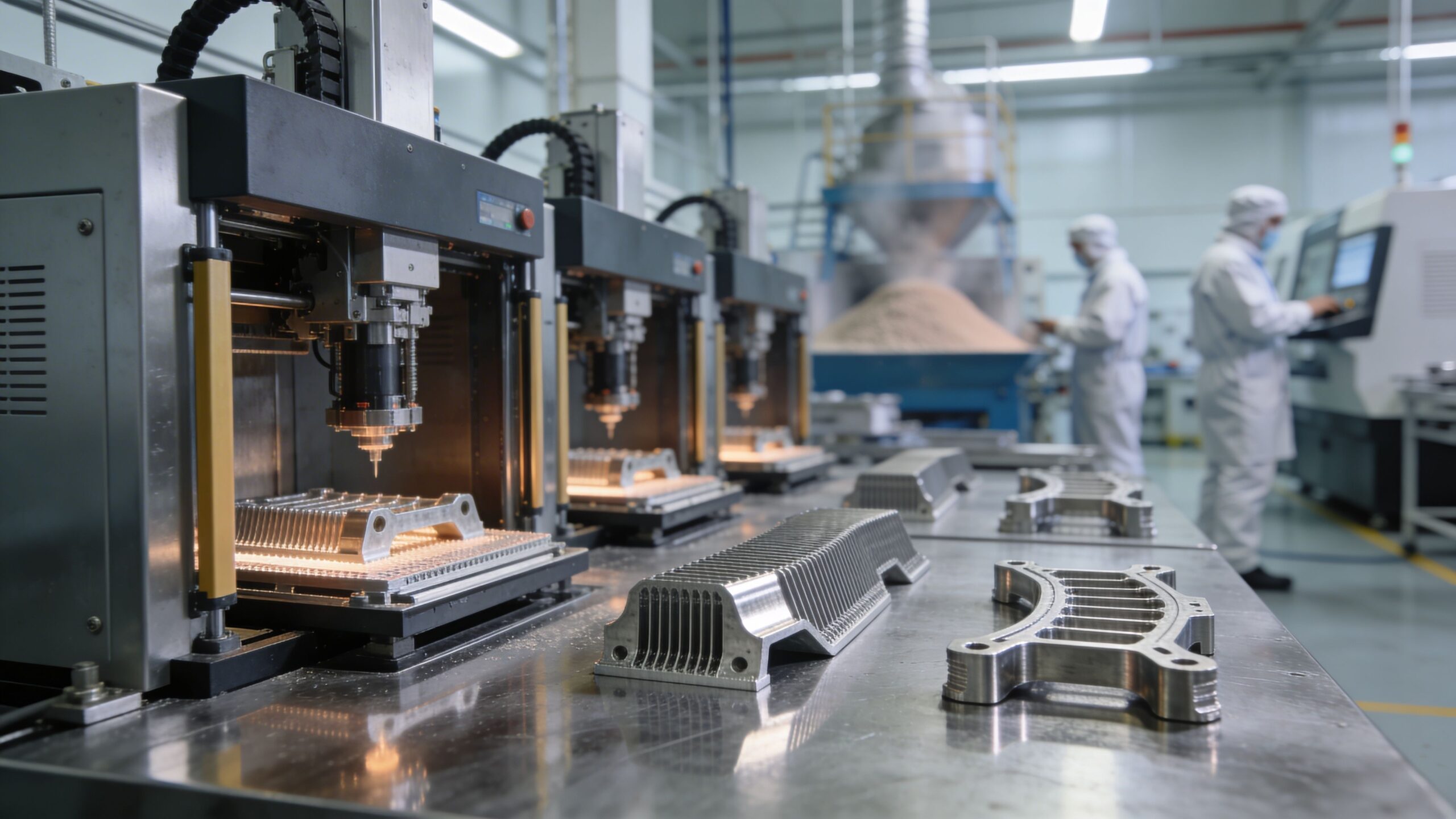
The Moment Aviation Started Printing Its Future
Aviation has always moved forward in leaps, not steps. New alloys, better aerodynamics, smarter avionics, quieter engines—each breakthrough pushes aircraft further, faster, and more efficiently than the generation before. Yet for decades, one part of the industry stayed stubbornly familiar: how most aircraft parts were made. Machining, casting, forging, and traditional assembly dominated the factory floor, and while those methods are incredibly refined, they come with a built-in set of constraints. Then additive manufacturing arrived with a different promise. Instead of shaping parts by cutting away material, it builds them layer by layer from a digital model. It’s a deceptively simple change that unlocks a cascade of possibilities. Internal channels that snake through metal like hidden plumbing. Lightweight lattice cores that maintain strength while shedding mass. Assemblies that shrink from dozens of parts to one. Rapid prototypes that move from screen to shop in days. That’s why 3D printed aircraft parts are no longer a novelty or a pilot program tucked in a research lab. They’re steadily becoming part of the real-world aviation ecosystem—changing how aircraft are designed, built, repaired, and upgraded.
A: Match the model, material, settings, and finish plan to the purpose of the print.
A: Bed leveling, surface cleanliness, nozzle height, temperature, and material condition are the usual suspects.
A: No. Slower speeds can improve detail, but heat buildup and profile balance still matter.
A: Use the right material, more walls, smart orientation, enough infill, and realistic load testing.
A: Temperature, retraction, travel moves, moisture, and material type all contribute.
A: Diagnose visible layer lines, fragile details, support scars, and oversized assemblies before buying parts.
A: Very important; it shows toolpaths, supports, layer changes, and possible weak spots before printing.
A: First layers, simple calibration prints, support cleanup, and basic material profiles.
A: Clean orientation, tuned settings, good material handling, and careful sanding, filling, priming, painting, sealing, and display mounting.
A: It is most useful for makers building display pieces, props, miniatures, and gifts.
What “3D Printed Aircraft Parts” Really Means
When people hear “3D printing,” they often picture desktop printers laying down plastic filament. Aviation’s world is different. Aircraft parts need to survive vibration, pressure changes, temperature extremes, and years of fatigue cycling. That means aerospace-grade additive manufacturing typically involves advanced polymers, composites, and—most importantly—metal printing.
Metal additive manufacturing often uses a process where a high-powered laser melts microscopic layers of metal powder into a solid part. The machine repeats this across thousands of layers until a complex component emerges from the powder bed. The raw print is only the beginning. Most aerospace parts also require post-processing like heat treatment, surface finishing, machining critical faces, and rigorous inspection. This is why aviation takes additive manufacturing seriously. It isn’t “press print and install.” It’s an engineered production method with tight process controls and repeatability requirements. When the workflow is done correctly, the payoff is enormous.
Why Aviation Loves Additive: Complexity Becomes a Strength
Traditional manufacturing thrives on simplicity. Straight holes and flat planes are easy to machine. Curved internal passageways and intricate shapes are harder. In aviation, the best designs often demand complexity, especially when it comes to airflow management, thermal control, and weight reduction.
Additive manufacturing turns complexity into an advantage. A part that would require multiple machining operations, specialized tooling, or complex welding can sometimes be printed as a single integrated geometry. Instead of designing around manufacturing limitations, engineers can design around performance.
This is how additive manufacturing changes aviation at its core. It expands the design space. When engineers can build shapes previously considered impractical, they can rethink how systems move air, transfer heat, route fluids, and carry loads. The result is parts that can perform better while simplifying assembly.
The Weight Game: Lighter Parts, Better Efficiency
Every airline operator knows fuel is one of the biggest costs of flight. In a world where margins can be thin and competition is fierce, even small efficiency improvements matter. Weight reduction is one of the most direct paths to better fuel economy, and 3D printing is an increasingly powerful tool for cutting weight.
A key reason is topology optimization. Engineers use software to “sculpt” a part around load paths, removing material that doesn’t contribute meaningfully to strength. The resulting structures can look organic, like bones or branching roots, because they mirror nature’s approach: strong where needed, hollow where possible.
Then there are lattice structures. Additive manufacturing can create internal lattices that maintain rigidity but dramatically reduce mass. These lattices can also be tuned for specific behaviors, like vibration damping or energy absorption. In aviation, where vibration and fatigue life matter, this is a big deal.
Over the life of an aircraft, lighter components can contribute to improved fuel burn and payload flexibility. Multiply that across fleets and years of operation, and the economic incentive becomes clear.
Part Consolidation: Turning Assemblies into Single Prints
Aircraft are complex machines assembled from thousands of parts, and every joint is a potential weak point. Bolts can loosen. Welds require inspection. Interfaces introduce tolerance stack-ups. And from a manufacturing perspective, each component adds cost, lead time, and procurement risk. Additive manufacturing offers a new strategy: part consolidation. Instead of assembling many pieces, engineers redesign systems so multiple components become a single printed part. This can reduce fasteners, simplify installation, and improve reliability by eliminating failure points.
A part that once required multiple welded sections might become one print. A bracket that previously needed separate cable clips might integrate those features directly. Ducting and airflow components can be printed with mounting points and internal flow features included, reducing assembly time and minimizing leak paths. Part consolidation also helps with quality control. Fewer parts can mean fewer inspections and fewer chances for mismatch. In an industry where reliability is paramount, reducing complexity is often as valuable as improving performance.
Cabin Interiors and Non-Critical Components: The Quiet Adoption Zone
Not every 3D printed aircraft part needs to be a high-stress structural bracket or engine component. One of the areas where additive manufacturing has quietly grown is in cabin interiors and non-critical aircraft components.
Interior parts such as vents, housings, brackets, trim elements, and ducting for air distribution can often be produced using high-performance polymer printing. For aircraft operators, one of the major wins is flexibility. If an airline needs a customized interior element or a replacement component for an older cabin configuration, additive manufacturing can provide solutions without retooling.
This also supports better inventory strategies. Instead of storing large numbers of rarely used interior spares, operators can keep digital designs and print parts as needed. This can reduce storage costs and improve turnaround times during maintenance. While these components might not grab headlines, they represent a meaningful part of additive manufacturing’s expansion in aviation.
Maintenance, Repair, and the “Need It Yesterday” Problem
One of the most exciting impacts of 3D printing in aviation is how it changes maintenance and repair timelines. Aircraft operations are schedule-driven. When a plane is grounded waiting for a part, the cost isn’t just the part—it’s the lost revenue and disrupted logistics that follow. Additive manufacturing can reduce lead times for certain parts, particularly those that are hard to source or no longer produced at high volume. If a replacement part requires new tooling or a specialized supplier, it can take weeks or months. Printing a qualified part can sometimes shorten that timeline significantly.
Additive manufacturing also supports repair strategies through processes that rebuild worn surfaces or add material back onto components. While not all repair printing is the same as “printing a whole new part,” it falls under the broader additive umbrella and can extend component life in cost-effective ways. The long-term vision is a more resilient aviation supply chain where digital inventories and qualified print networks support faster returns to service.
Engines and Thermal Components: The High-Performance Frontier
When people talk about aviation’s most demanding environment, the conversation always returns to propulsion. Engines operate at extreme temperatures, with high pressures and tight performance requirements. Any improvement in airflow, cooling, or fuel delivery can deliver measurable efficiency gains.
Additive manufacturing enables designs that support better thermal management. Parts can be printed with internal channels that guide cooling fluid exactly where it’s needed. Heat exchangers can be printed with extremely high surface area packed into compact volumes. Fuel delivery components can include complex internal passageways that improve mixing and reduce inefficiencies.
These benefits make additive manufacturing attractive for engine-related components, though the certification and quality requirements are strict. When additive parts are qualified and deployed, they can deliver meaningful performance improvements while reducing part count and manufacturing complexity.
The Certification Challenge: Why “Printing It” Isn’t Enough
Aviation is built on trust. Every part must meet stringent standards, and additive manufacturing must prove it can deliver consistent, repeatable results. This is one reason adoption can feel slower than the technology’s potential suggests. The printed part’s quality depends on many factors: powder consistency, machine calibration, build orientation, thermal history during printing, and post-processing procedures. Even subtle variations can impact fatigue life or mechanical performance. That’s why aviation companies invest heavily in process control, monitoring, and inspection.
Non-destructive testing plays a major role. Advanced scanning methods can look for internal defects that aren’t visible from the surface. Mechanical testing verifies properties under stress and temperature cycles. Documentation tracks every step from powder batch to finished component. This rigorous approach is not a barrier—it’s the reason additive manufacturing becomes viable in aviation. Once a process is controlled and qualified, printed parts can be deployed with confidence.
What This Means for the Future of Aviation
3D printed aircraft parts are not replacing traditional manufacturing overnight. Machining, casting, and forging will remain essential for many applications. But additive manufacturing is increasingly becoming a key tool in the aviation manufacturing toolkit, especially for parts where complexity, weight reduction, and supply chain flexibility matter most.
As materials improve and certification pathways mature, additive manufacturing will expand into more flight-critical and high-performance components. Aircraft will gradually incorporate more printed parts as programs evolve and production ecosystems become more mature.
At the same time, the most transformative shift might not be about any single part. It might be about how aviation thinks about manufacturing. Digital design files that travel faster than physical parts. Factories that print complex components with fewer steps. Supply chains that become more resilient through distributed production. Maintenance ecosystems that rely on digital inventories rather than warehouses full of spares. Aviation has always been about mastering air and distance. Additive manufacturing adds a new kind of mastery: building what you need, when you need it, in shapes that weren’t possible before. That is how 3D printing is changing aviation—quietly at first, then all at once.
Practical Next Steps
Before applying this topic to a real print, use the following checks to connect the idea to a specific part, material, printer, and workflow.
- Separate prototype value from production value: the same part may need different evidence at each stage.
- Check qualification, repeatability, inspection, post-processing, and documentation before assuming a printed part is production-ready.
- Look for applications where weight reduction, part consolidation, tooling speed, or spare-part availability matters.
- Consider the whole cost: machine time, material waste, finishing, labor, failed builds, and quality control.
FAQ
Why do companies use 3D printing in production?
They use it when speed, weight reduction, part consolidation, tooling flexibility, customization, or spare-part availability creates a real advantage.
What makes an industrial printed part trustworthy?
Repeatable process data, qualified materials, inspection, post-processing controls, documentation, and testing make production use more credible.
Is 3D printing always cheaper for industry?
No. It can be cheaper for the right geometry or volume, but machine time, material, finishing, labor, and qualification can outweigh the benefit.
Sources and Further Reading
Use these references to verify terminology, process limits, material behavior, and design guidance related to this topic.