The Best Filament Depends on What Happens After Printing
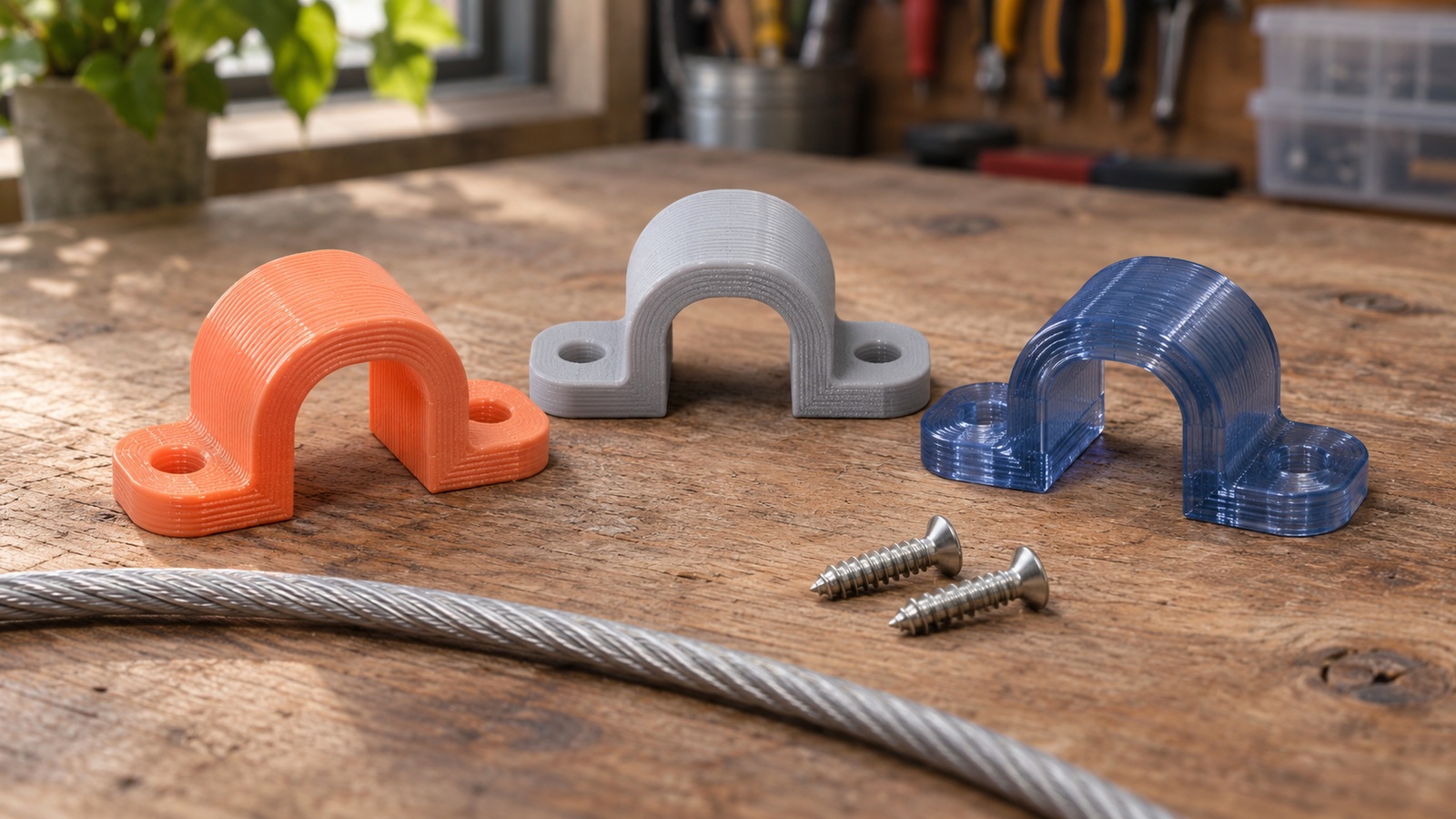
Print the same cable clamp in PLA, ABS, and PETG, and all three may look capable of doing the job. Their differences become clearer when the clamp is tightened, warmed, knocked, or left under load. PLA is a familiar starting point for clean, stiff prints, PETG often suits practical parts that benefit from a little more give, and ABS can be useful when its thermal behavior and finishing options justify a more demanding printing environment. None wins every comparison, and broad material labels hide differences between individual grades. The useful choice connects the object’s service conditions with what your printer and workspace can consistently produce. This guide compares the three through common workshop decisions, explains where easy assumptions go wrong, and shows how to test a material change without confusing a successful print with a reliable finished part.
A: Not necessarily. At the same filament diameter, length per unit mass depends on the product density. Compare the supplied length or the actual material data when estimating how far a roll will go.
A: No; change materials when the new behavior addresses a defined requirement.
A: ABS responds to acetone in a way that permits that specialized finishing route. It is not a transferable PLA or PETG recipe; solvent finishing requires an appropriate process and the relevant chemical handling controls.
A: Material flow, surface deposits, contraction, and flexibility can alter the effective fit.
A: The boss geometry, printed surface, and material response can change the contact during tightening. Check the installed connection rather than compensating automatically with more force.
A: No. Filament diameter must match the supported feed hardware. Choosing a PETG profile changes preparation settings, not the mechanical dimensions of the feed path. Buy the diameter specified for the actual printer.
A: Inspect whether its opening returns to the intended shape and whether the cable is actually retained. Easy release and useful grip are separate requirements of that mechanism.
A: ABS combines different contributions: butadiene supports ductility and impact response, while styrene contributes stiffness. The complete material is a rigid engineering plastic rather than the flexible filament its rubber-related ingredient might suggest.
A: PETG identifies a glycol-modified form of polyethylene terephthalate. Keep that distinction when discussing feedstock; a PET object and a purchased PETG filament are not interchangeable product descriptions.
A: No. They are related copolyesters with different chemical compositions. UltiMaker, for example, identifies its CPE+ material as PCTG and distinguishes it from its PETG offering.
PLA Makes an Approachable Baseline
PLA, or polylactic acid, is widely used for models, organizers, prototypes, and many general household prints. It commonly prints with relatively modest thermal demands and less warping difficulty than ABS, making it a convenient baseline for learning a machine. Its stiffness can also be useful when an object should hold its shape under light handling. A neatly printed PLA fixture or display model is not automatically a temporary or inferior object simply because the material is beginner-friendly.
The limitations appear when the design asks for behavior outside that comfortable range. Ordinary PLA can lose useful rigidity in warm conditions, and a thin feature may fail abruptly when bent beyond what it can tolerate. A part used near a heat source or inside a hot vehicle therefore needs more thought than a desk organizer. Consider the actual temperature and load together, because an unloaded sample that retains its appearance does not prove that a loaded bracket will hold its shape.
PETG Often Fits Practical Everyday Parts
PETG, a glycol-modified polyester, is commonly chosen for functional prints where some yielding behavior and practical durability are helpful. It can suit covers, brackets, containers for appropriate noncritical uses, and parts that receive regular handling. Compared with ordinary PLA, a suitable PETG grade may provide a more forgiving response to bending or impact. However, a flexible feel does not mean a part is automatically stronger in every loading condition, and the same geometry may need adjustment after a material swap.
Printing behavior also changes. PETG can produce strings or deposits if the profile, material condition, or travel behavior is poorly matched. It may adhere strongly to some build surfaces, so follow the sheet manufacturer’s guidance about preparation and release layers. A clean result depends on a stable profile rather than simply increasing nozzle temperature until the plastic flows. Surface marks and excess material around small features can affect fit even when the main body looks sound.
Use PETG because its properties solve a real requirement, rather than because it is presented as the universal next step after PLA. A crisp decorative miniature may still be easier to produce in PLA, while a warm, heavily loaded fixture may require a more capable material than either. Prusa’s material guide provides a starting point for comparing these filament families and their printer requirements. The exact supplier grade remains the proper reference for the final choice.
ABS Rewards a Suitable Printing Environment
ABS, or acrylonitrile butadiene styrene, is useful when its thermal behavior or finishing options justify a more demanding printing setup. It contracts as it cools, so larger shapes can warp or split when temperature differences are poorly managed. A heated bed and a suitable enclosure help address that thermal problem. The enclosure’s heat-retention role is separate from the workspace’s emission controls; keeping the build warm does not establish adequate exposure control.
Consider a prototype cover whose screw bosses must retain the lid beside a warm device. An appropriate ABS grade may offer a useful thermal margin over ordinary PLA, provided its documented properties and the actual loaded cover support that choice. The advantage is keeping the interface useful in that environment, rather than gaining the label of a professional material. Prusa’s ABS guide identifies heat-resistant technical parts as a relevant application. A cool desk model that never encounters that condition may gain little from the extra thermal-management work.
Compare Heat, Stiffness, and Long-Term Shape
Heat resistance is not one universal temperature printed on a spool. Technical sheets may report glass transition, heat-deflection temperature, or another measurement, each describing a different phenomenon or test. A useful comparison must connect those numbers to the part’s load, duration of exposure, and acceptable deformation. An enclosure near electronics, a sunlit object behind glass, and a decorative model on a shelf can experience very different conditions. If thermal behavior is decisive, review the exact product data and run a controlled representative test instead of relying on a generic online temperature threshold.
Stiffness describes how much a part resists deformation, while toughness concerns its ability to absorb energy before breaking under a specified test. These qualities are easy to confuse when comparing samples by hand. A stiff PLA piece may feel more substantial than a more yielding PETG piece, yet the latter may tolerate a particular bump better. Neither observation provides a complete ranking because geometry, layer bonding, and the direction of force influence what happens next.
Sustained loading introduces creep: deformation that develops while force remains applied. A shelf clip, clamp, or hanging bracket can change shape over time even if it survives the first installation. Temperature can make that problem more pronounced. Test the part under representative service conditions, and consider ribs, wall thickness, or a different load path before assuming that switching polymers will solve every issue.
Prepare Each Material for Its Own Profile
A fair comparison begins with usable feedstock, a free-running spool, and the build-surface treatment appropriate to each polymer. Store the exact products as their suppliers recommend and dry them only through an applicable procedure when needed. Prepare PETG’s sheet for the specified release behavior rather than copying the surface treatment used for PLA, and establish the supported printing environment before an ABS trial. Check that the selected nozzle can handle any additives in the purchased grade. These steps keep a preparation mistake from deciding the comparison before the clamp is even assembled. They do not require identical settings: each material should receive conditions suited to it, while the feature being compared remains meaningful.
Warping and Layer Bonding Change the Practical Result
Cooling causes dimensional change, and uneven cooling can pull corners away from the build surface or create stress within the object. Large flat parts and sharp corners can expose these issues more strongly than small rounded samples. PLA often makes the easiest starting point, PETG introduces its own adhesion and stringing considerations, and ABS generally asks for more careful temperature management. The shape you intend to print matters as much as the comparison made using a tiny demonstration piece.
Layer bonding also depends on the printing conditions. An underheated or poorly extruded part can fail along layer interfaces regardless of the material’s reputation. Rotating the object can change how the service load crosses those interfaces, sometimes producing a larger improvement than a spool change. When a part breaks, examine the fracture and the toolpath plan before deciding that the polymer itself was the sole cause.
Keep the comparison controlled. Use suitable profiles for each material while retaining the critical geometry and recording orientation, wall arrangement, and finishing. Copying the exact same temperatures and cooling settings across PLA, PETG, and ABS would not be a fair test because they have different processing needs. The goal is to compare achievable finished parts, not to see which material happens to survive another material’s profile.
Judge the Finished Clamp Through Assembly
PLA can produce crisp-looking details and comes in many appearance-focused formulations, while PETG often has a glossier character that makes deposits and strings more noticeable. ABS can suit certain finishing operations, but any chemical finishing process needs the appropriate product instructions and handling controls. Sanding, painting, and adhesive compatibility depend on the specific product and the desired result. Try the finishing sequence on a spare sample before committing to a highly visible part.
Assembly deserves the same trial. Screw bosses can split, snap fits can bind, and holes can need adjustment after changing materials. The flexibility that helps a latch may allow a thin panel to bow, while a stiffer panel may transfer more stress to a fragile corner. Check fit with the real hardware and evaluate the force needed for installation. A material that looks best before assembly may not deliver the best finished object.
Print the clamp feature in the realistic candidates using their appropriate profiles. Keep its cable opening and fastening arrangement, then install it with the cable it is intended to hold. Check whether tightening bows the body, whether the opening pinches the jacket, and whether the cable can be removed as intended. For a repeatedly opened design, inspect the flexing neck and the force needed to release it. Those observations connect the comparison to a useful object rather than an arbitrary attempt to snap three unrelated samples.
For a warm or continuously loaded installation, extend the evaluation to the conditions that matter there. Check the retained gap and fastening behavior after the relevant exposure, using an appropriate engineering test where the consequences require one. A clamp can remain unbroken while gradually losing its grip or squeezing the cable differently. Keep the observed change associated with its material and geometry so the next choice addresses the actual limitation. All three materials still require suitable operation and exposure controls; NIOSH’s safe 3D printing guidance provides context for shared workshops and small businesses.
Choose the Filament for the Clamp You Need
For a cable organizer on a cool desk, PLA is often the sensible first candidate: it is approachable to print and can keep a modest, rigid shape. PETG deserves consideration when the design benefits from a more yielding release action or frequent handling. ABS becomes a candidate when the installation needs thermal behavior available from a suitable grade and the printer can process it consistently. These are different reasons to choose a material, rather than successive upgrades that every maker must purchase.
Return to the cable clamp from the opening. Keep PLA if its body stays in shape and its simple installation works in the cool location. Compare PETG if the release neck is the troublesome feature and its different response makes that motion more useful. Assess ABS or another suitable material if temperature and fastening load make the earlier candidates unsuitable. In every case, a sharp internal corner or a poorly oriented layer interface can undermine the choice, so retain the geometry that made the trial informative.
Move beyond this shortlist when the job demands weather resistance, chemical compatibility, repeated high-strain motion, or thermal performance that the available products cannot demonstrate. It is better to broaden the material search than force one of three familiar spools into every application. The winning filament is the one that gives this clamp the required shape, release action, and behavior in its intended location through a manageable printing process. Keep that conclusion attached to the actual use, and the next material decision becomes easier to explain.