Useful Beginner Prints Build Skill
The best beginner prints are practical, small, and forgiving. They help a new owner learn bed adhesion, wall strength, supports, tolerances, and material behavior while making objects that are actually useful.
A: Match the model, material, settings, and finish plan to the purpose of the print.
A: Bed leveling, surface cleanliness, nozzle height, temperature, and material condition are the usual suspects.
A: No. Slower speeds can improve detail, but heat buildup and profile balance still matter.
A: Use the right material, more walls, smart orientation, enough infill, and realistic load testing.
A: Temperature, retraction, travel moves, moisture, and material type all contribute.
A: Diagnose poor first layers, weak parts, stringing, warping, and rough surfaces before buying parts.
A: Very important; it shows toolpaths, supports, layer changes, and possible weak spots before printing.
A: First layers, simple calibration prints, support cleanup, and basic material profiles.
A: Clean orientation, tuned settings, good material handling, and careful support removal, sanding, painting, fitting, and practical testing.
A: It is most useful for makers who want cleaner prints and fewer wasted attempts.
Useful Beginner Prints Build Skill
The best beginner prints are practical, small, and forgiving. They help a new owner learn bed adhesion, wall strength, supports, tolerances, and material behavior while making objects that are actually useful.
Start with PLA and simple geometry unless the project needs another material. Useful does not mean complicated.
Desk and Home Prints
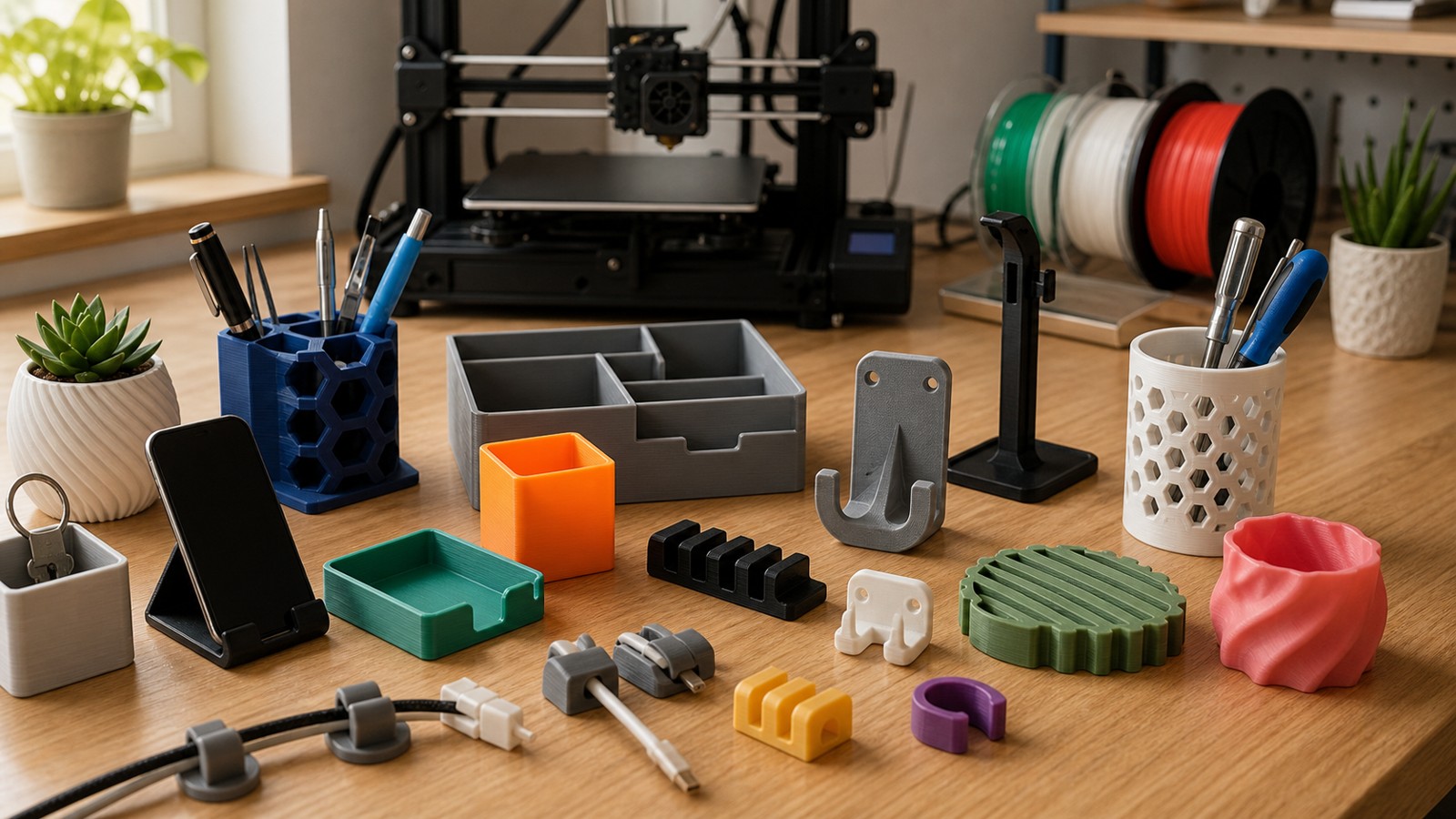
Good first projects include cable clips, cord wraps, drawer dividers, plant labels, bag clips, hooks, phone stands, headphone hangers, shelf pins, light-duty brackets, and small trays.
These teach scale, surface quality, and strength without requiring advanced supports or tight tolerances.
Workshop Prints
Workshop prints include tool holders, drill-bit organizers, sanding blocks, measuring jigs, dust caps, clamp pads, small bins, wall mounts, and router or saw accessories. Use PETG when parts need more toughness than PLA.
Do not use untested prints for safety-critical loads. A printed hook for a light cable is different from a printed bracket holding heavy equipment.
Learning Prints
Learning prints include calibration cubes, temperature towers, retraction towers, tolerance gauges, bridge tests, and overhang tests. They may not be exciting, but they explain the printer.
Print one test when solving one problem. A targeted test is more useful than randomly changing settings on a large model.
Gift and Hobby Prints
Beginner-friendly gift prints include key tags, bookmarks, game token trays, simple terrain, cookie cutters for decorative use, name plates, ornaments, and small display stands.
For food-adjacent objects, remember that layer lines can trap residue and material safety is complicated. Use caution before treating printed parts as food-safe.
How to Choose the Next Project
Pick a project that adds one new skill: supports, fit, flexible material, stronger walls, heat resistance, or finishing. That keeps progress steady without making every print a troubleshooting puzzle.
A beginner who prints useful objects learns faster because each object gets handled, tested, and improved.
FAQ
What useful thing should a beginner 3D print first?
Cable clips, bag clips, plant labels, drawer dividers, and phone stands are good early useful prints.
What material is best for useful beginner prints?
PLA is easiest, while PETG is better for tougher practical parts.
Are 3D printed hooks safe?
Use printed hooks only for light-duty applications unless the design, material, orientation, and load have been tested carefully.