A Good First Print Teaches One Lesson
The best first 3D prints are small, useful, and easy to inspect. They teach bed adhesion, dimensional accuracy, support behavior, bridging, surface finish, or basic strength without risking a long failed print.
A: Match the model, material, settings, and finish plan to the purpose of the print.
A: Bed leveling, surface cleanliness, nozzle height, temperature, and material condition are the usual suspects.
A: No. Slower speeds can improve detail, but heat buildup and profile balance still matter.
A: Use the right material, more walls, smart orientation, enough infill, and realistic load testing.
A: Temperature, retraction, travel moves, moisture, and material type all contribute.
A: Diagnose poor first layers, weak parts, stringing, warping, and rough surfaces before buying parts.
A: Very important; it shows toolpaths, supports, layer changes, and possible weak spots before printing.
A: First layers, simple calibration prints, support cleanup, and basic material profiles.
A: Clean orientation, tuned settings, good material handling, and careful support removal, sanding, painting, fitting, and practical testing.
A: It is most useful for makers who want cleaner prints and fewer wasted attempts.
A Good First Print Teaches One Lesson
The best first 3D prints are small, useful, and easy to inspect. They teach bed adhesion, dimensional accuracy, support behavior, bridging, surface finish, or basic strength without risking a long failed print.
Avoid making the first print a giant helmet, articulated dragon, or complicated mechanical assembly. Start with something that finishes quickly and shows whether the printer is healthy.
Calibration Cube
A 20 mm calibration cube is useful because it checks scale, corners, surface consistency, and basic extrusion. It will not prove everything, but it gives a quick snapshot of printer behavior.
Measure it with calipers if you have them. If the cube is rough, undersized, oversized, or warped, fix that before printing more ambitious parts.
First-Layer Patch
A flat square or bed-level test shows whether the first layer is too high, too low, or uneven across the plate. This print is boring in the best way because it catches problems early.
Use it whenever changing a nozzle, bed surface, filament type, or printer location.
Useful Beginner Objects
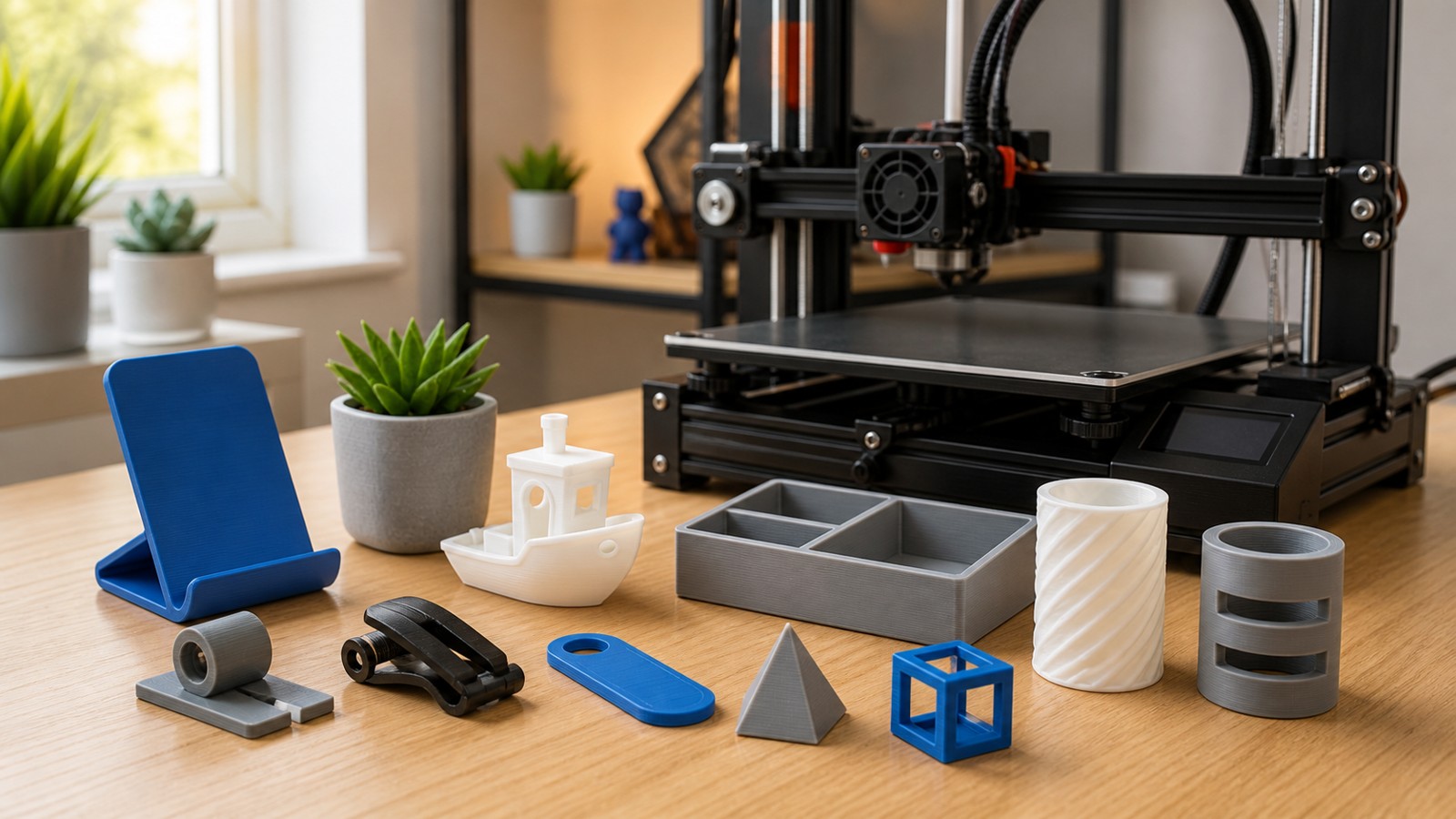
Good early prints include a cable clip, bag clip, phone stand, small hook, drawer divider, key tag, plant label, tool holder, or simple box. These objects show how printed parts behave in daily use.
Choose models with broad bed contact, few supports, and clear function. A first useful part is more motivating than a perfect decorative sample.
What to Avoid at First
Avoid tall skinny prints, large flat plates, complex support-heavy models, tiny detailed miniatures on FDM, and multi-part assemblies with tight tolerances. These are all good projects later, but they stack too many variables early.
Once the printer makes simple parts reliably, add one challenge at a time: supports, hinges, threads, flexible material, or fine detail.
FAQ
What should my first 3D print be?
A small calibration cube, first-layer patch, cable clip, or simple useful object is a good first print.
Should I print a Benchy first?
A Benchy is useful after basic setup, but a first-layer test and small cube are often better first checks.
How long should a first print take?
A first print should usually be short enough that failure is not costly, often under an hour or two.