Four Changes That Could Make 3D Printing Feel Different in 2030
By 2030, a production engineer might order a printed component through the factory’s ordinary manufacturing system, a design team might operate a smaller industrial powder machine, and a metal printer might adjust a defined part of its process while the build is running. In a research laboratory, specialized equipment could make delicate structures that today’s general-purpose printers cannot handle. These are four different possibilities, with different obstacles between a promising system and everyday usefulness. This outlook starts from named developments documented by late 2026: BMW’s production integration, HP’s compact industrial platform, NIST’s process-control research, and a lung-scaffold programme described by 3D Systems. It then explains what each could change by 2030 and what would have to happen first. The forecasts are the article’s inferences from those sources; they are not announced delivery commitments or claims that every application will progress at the same pace.
A: BMW expands the project name as Industrialization and Digitalization of Additive Manufacturing. It concerns industrial metal-printing integration, rather than a new feedstock name.
A: The partner account describes an automated polymer production chain, including transport between process equipment. The two projects address different process routes.
A: HP names Anima Design. Its designers discuss physical design validation within their existing workflow.
A: No. HP describes the dedicated preparation software as part of Materialise’s CO-AM ecosystem, not as the entire ecosystem.
A: NIST provides benchmark measurements and defined challenge problems against which modelling approaches can be examined. The published problem supplies the comparison, rather than letting every model choose its own target.
A: It lets researchers combine controlled laser processing with the facility’s high-energy X-ray measurements of events inside the material. That provides another experimental view of the physical process.
A: The OpenVDB project identifies it as integration with Wolfram Mathematica, contributed by United Therapeutics in 2022. It connects two software environments.
A: No. Its history begins at DreamWorks Animation, and the project was open-sourced in 2012. The later biomedical connection illustrates how software from another field can find a different application.
A: The reported optical arrangement uses it for fine features while moving the projected image across a larger area. Overall object size and the size of one exposed field are different quantities.
A: No. Programmable hardware can implement defined logic or control equations without a learned model. Its ability to perform operations quickly does not prescribe one algorithm.
Factories Could Treat Printing as an Ordinary Production Route
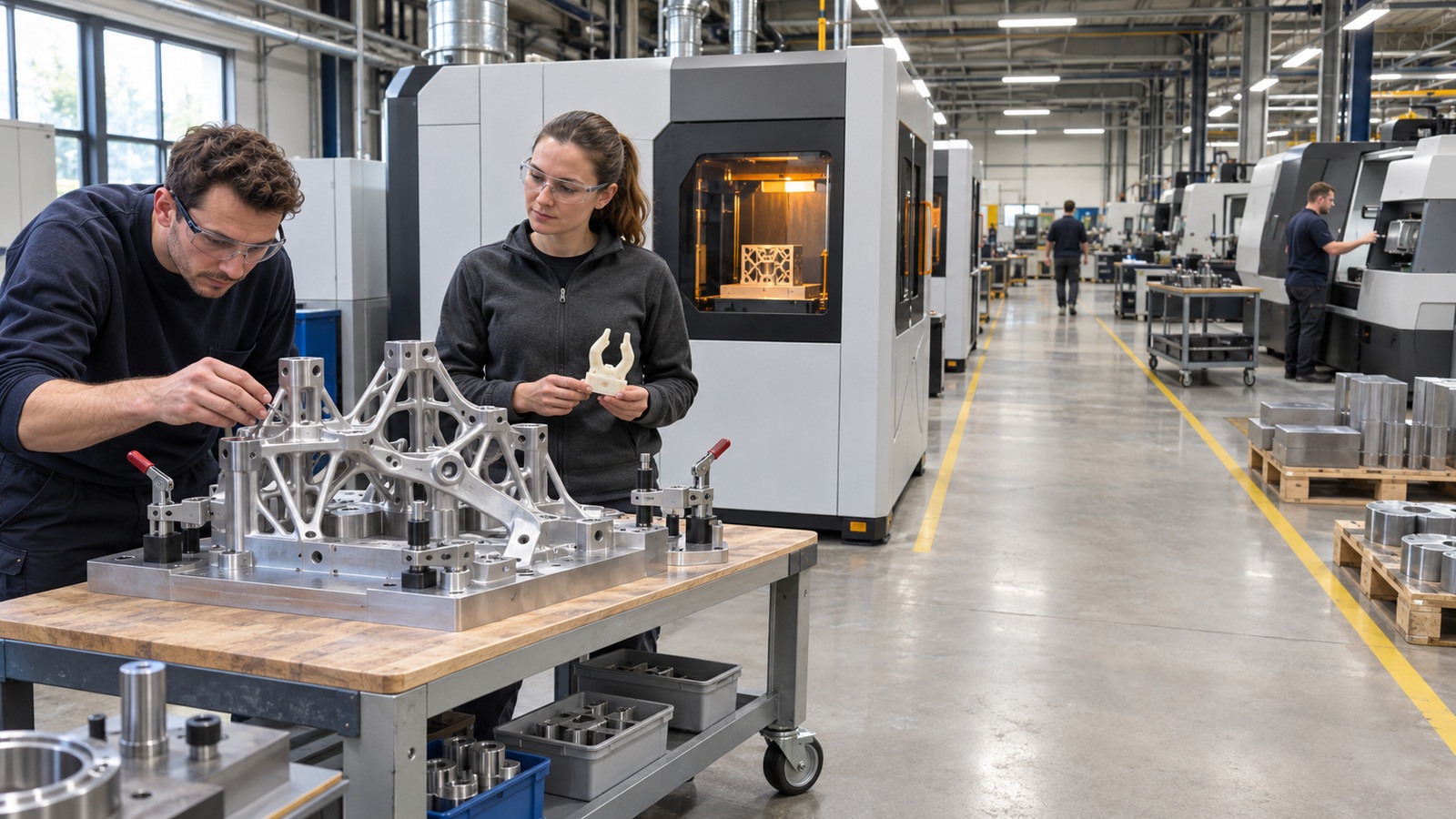
BMW’s March 2026 manufacturing account describes automated process chains and open interfaces as part of its scaling strategy. It reports integrating central subprocesses from the IDAM project into its campus and identifies WAAM series production from 2027 as a next step. The 2030 inference is broader integration into selected production tasks: a part moving through an established factory route instead of being managed as an isolated experiment beside it.
For an engineer, that would change the work surrounding the request. A suitable job could enter a known queue with a defined material, build arrangement, finishing route and destination. The interesting advance would be less dependence on a specialist manually shepherding every handoff. This could make printing easier to use repeatedly within a factory without making it the preferred process for all components. A casting or machined part would still follow its own route when that route serves the job better.
Integration Has to Solve Physical Transitions
Consider a metal component that needs a machined locating face after printing. Its next operation requires more than a message saying the build has finished. The receiving station must hold the part in a useful orientation, reach the intended surface and distinguish stock awaiting machining from material that should remain. An integrated route makes those transitions predictable. It does not require the additive machine to perform every operation itself.
Material changes create another practical boundary. A factory can connect several machines digitally while still needing a controlled physical changeover between feedstocks. The same handling container may not suit wire, loose powder and a hot unfinished component. By 2030, useful automation could therefore look like several well-matched cells rather than one universal machine surrounded by interchangeable accessories. Interfaces should make each cell’s capabilities legible to the rest of production.
The milestone to watch is a recurring part family moving through its intended sequence with less intervention at the transitions. For example, does a machine’s output arrive in a condition that the next station can actually accept? A pallet that places the component where the fixture expects it represents a concrete improvement. A dashboard showing a finished build does not perform that physical placement. The gain concerns the connection between operations, not the appearance of a more elaborate control room.
This is a relatively strong forecast because it extends work manufacturers already organize around specific applications. Its pace will depend on whether the same arrangement handles a useful range of jobs. A dedicated cell can be productive for a stable part family but awkward when the geometry changes radically. Expect some highly integrated routes and some flexible, operator-led workspaces to coexist. Different production mixtures give factories different reasons to automate.
Smaller Industrial Systems Could Reach More Design Teams
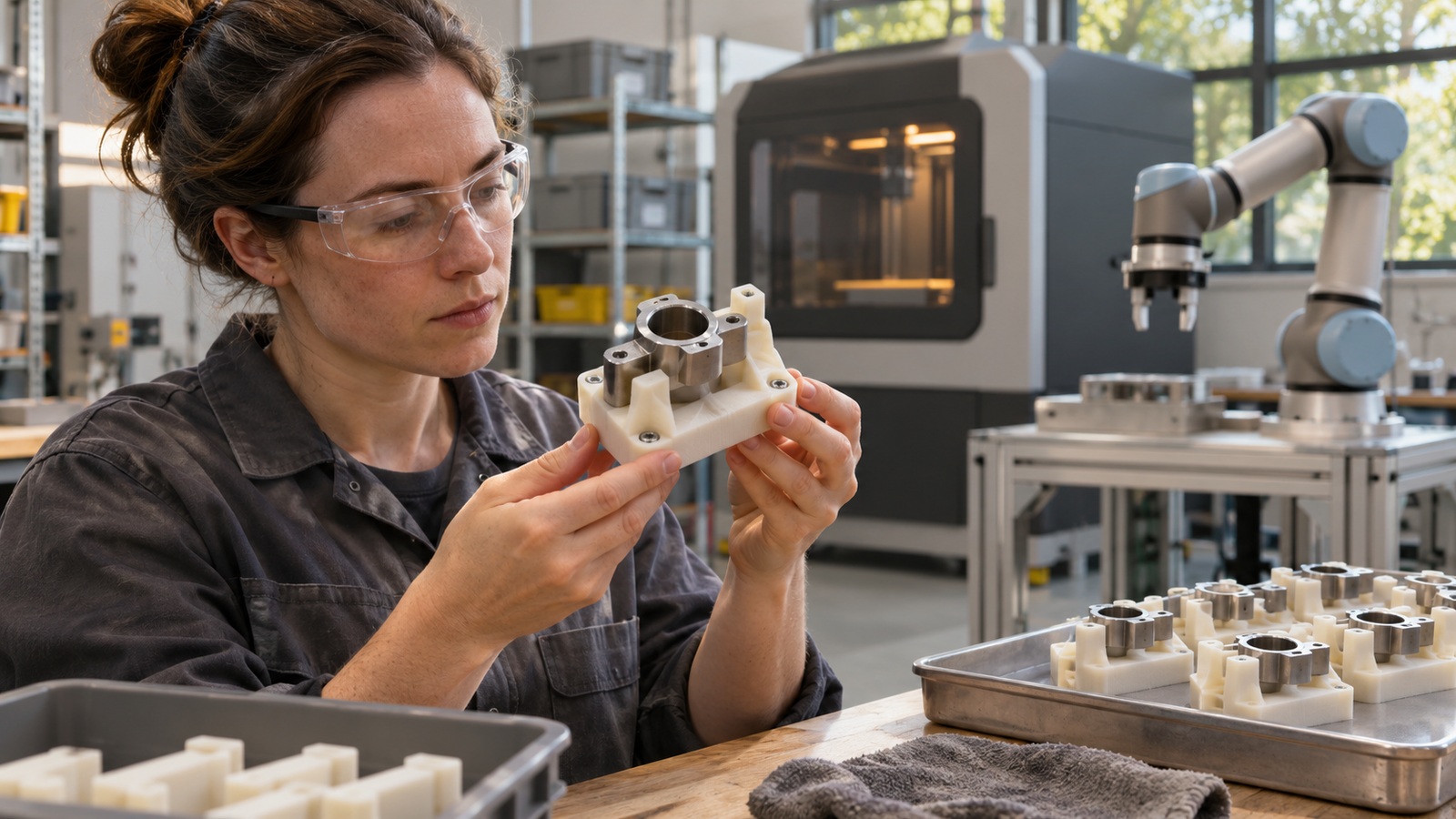
HP’s April 2026 announcement presents the MJF 1200 as a compact polymer system with a 12-liter build volume, guided operation and automated unpacking, material mixing and preparation features. It also identifies Magics Print for HP as included build-preparation software. The announcement schedules the complete solution for early 2027; this outlook does not assume that schedule has already been fulfilled. The 2030 possibility is industrial powder processing reaching more engineering teams through a packaged workflow, rather than only through large centralized facilities.
Access Could Change How a Team Iterates
A design office making several versions of a small enclosure could benefit from producing those versions within its own working rhythm. The change is especially useful when the team must handle the pieces together and revise an interface before the next design meeting. It is less compelling when occasional outside orders already arrive at the required pace. A smaller machine expands the ownership option; it does not make ownership the only convenient way to obtain parts.
The practical obstacle is fitting the whole process into that team’s routine. Someone must prepare the build, manage the material, recover the objects and keep the equipment in useful condition. A compact build chamber does not tell you how much bench space the surrounding activities require. Nor does a guided interface decide whether several unrelated jobs belong in one batch. Those remaining decisions explain why a smaller industrial machine could be valuable in an engineering workshop while still being unsuitable for an ordinary home desk.
A meaningful milestone would be an engineering group completing its normal revision work without repeatedly handing the troublesome stages to an external specialist. Observe the mix of actual objects and how often the system fits that work. Small enclosures, delicate clips and large fixtures occupy the machine differently. The expected 2030 outcome is a wider range of workable local setups, not identical printers in every office. External services can remain the practical route for jobs outside a team’s equipment and experience.
Metal Printers Could Correct Particular Conditions During a Build
NIST’s Advanced Machines, Monitoring, and Control programme describes pointwise control that varies laser power and speed, alongside research on feedback, scan strategies and thermal behaviour. Its AMMT and LPDT platforms provide named experimental foundations. The plausible 2030 advance is selective adaptation: a system making a defined adjustment because a measured process variable has departed from its intended condition.
Picture a controller changing a laser input near a region that retains more heat than the preceding scan. That differs from a camera simply recording the event for someone to examine later. It also differs from software rewriting the entire component whenever a surface looks unusual. A useful controller needs a narrow, well-understood relationship between what it measures and what it can change. Such a system can improve a particular operation without becoming a general-purpose judge of finished-part quality.
The Hard Part Is Choosing the Right Response
A measurement has to represent something the controller can use. A brighter signal might reflect a changed process condition, but the instrument and viewing arrangement also influence what it records. An adjustment based on the wrong interpretation could move the process away from its intended state. That is why the control target should be explicit. Keeping one observed variable stable is a different task from proving every internal feature of the eventual component.
The actuator also has limits. Laser power cannot rise indefinitely, and a motion command cannot demand an instantaneous change that the equipment cannot execute. A controller that repeatedly reaches its limit may no longer provide the response assumed by its design. The useful result is a bounded adjustment that the real machine can deliver. A convincing demonstration should show where that operating range begins and ends.
Timing adds another distinction. An intervention made during the scan can address a different event from a change applied before the next layer. Some effects are already fixed into the material by the time an observation becomes available. Others can be influenced by the subsequent thermal history. By 2030, expect several kinds of feedback and advance planning to coexist because no single response interval suits every physical event.
The observable milestone is a controlled comparison in which the chosen intervention improves the relevant feature or material condition across the tested operating range. NIST’s report on monitoring and nondestructive evaluation provides background on relating process observations to defects and final quality. The forecast becomes stronger when results extend beyond a conveniently steady scan to transitions such as starts, stops or changing geometry. That would show a controller handling a real source of variation rather than merely reproducing a narrow reference condition.
Some of this progress may be largely invisible to a person ordering the finished part. They may encounter a more consistent service or a wider choice of qualified features without ever seeing the sensor stream. Operators, however, will need to recognize when the controller has reached its permitted boundary and when a job needs another route. Automation can change the decision point instead of eliminating it. This makes targeted process control a more plausible near-term outcome than a printer that autonomously approves any component sent to it.
Research Printers Could Handle Softer, More Detailed Structures
In a 2026 account of its work with United Therapeutics, 3D Systems describes specialized printing of full-size lung scaffolds and reports 24 machines running in a research laboratory. The account identifies extremely soft material, fine detail and data handling as engineering challenges, and explicitly describes transplantable lungs as continuing research. The more defensible 2030 forecast is improved capability to fabricate delicate research structures, alongside continued biological investigation. Routine printed replacement organs would require a much larger leap than manufacturing a scaffold.
Soft Structures Put Fabrication and Biology on Different Tracks
For fabrication, the challenge is retaining many small features across a much larger object. A structure can be damaged while fresh material is introduced even when the light pattern is correct. Increasing exposure alone would not remove that mechanical disturbance. Better handling of soft layers could therefore unlock useful experiments that are difficult with equipment designed around stiffer objects. The immediate beneficiary would be a research team able to fabricate and investigate a structure that previously collapsed or became impractical to represent.
Biological progress needs a different milestone: evidence that the intended living system functions under the conditions being investigated. A fabricated scaffold supplies an arrangement for that work; it does not by itself establish a patient outcome. This is the lowest-confidence area of the four forecasts because fabrication advances and biological success need not proceed together. Through 2030, substantial laboratory progress could coexist with unresolved clinical challenges. The useful development to follow is which specific experimental capability becomes possible, rather than whether every organ-shaped object receives the same dramatic headline.
Expect Uneven Progress Across These Four Futures
The factory-integration forecast concerns connecting operations that already have recognizable production roles. The compact-system forecast concerns which organizations can reasonably bring an industrial workflow in-house. The feedback forecast concerns acting on selected measurements quickly and appropriately. The soft-structure forecast concerns expanding what specialized research tools can fabricate. These outcomes can progress independently: a simpler local polymer setup does not require a breakthrough in metal control or regenerative medicine.
For a small manufacturer, 2030 could therefore mean fewer improvised handoffs and more accessible choices for recurring work. For an engineering group, it could mean shorter loops between examining a physical model and deciding the next design change. For a metal-process specialist, it could mean supervising a bounded adaptive system rather than selecting every input in advance. Researchers may gain tools for new structures while still confronting unanswered biological problems. Those are tangible changes in a working day, even if the basic act of building objects layer by layer remains familiar.
The strongest outlook is selective expansion, with the most confidence in applications that already have a defined production task. Watch for functioning connections between machines, useful compact installations, validated interventions and newly feasible research structures. Each supplies a different reason to revise this forecast as evidence develops. By 2030, 3D printing could be less conspicuous as a novelty and more consequential as one of the tools people routinely choose to solve a particular problem.