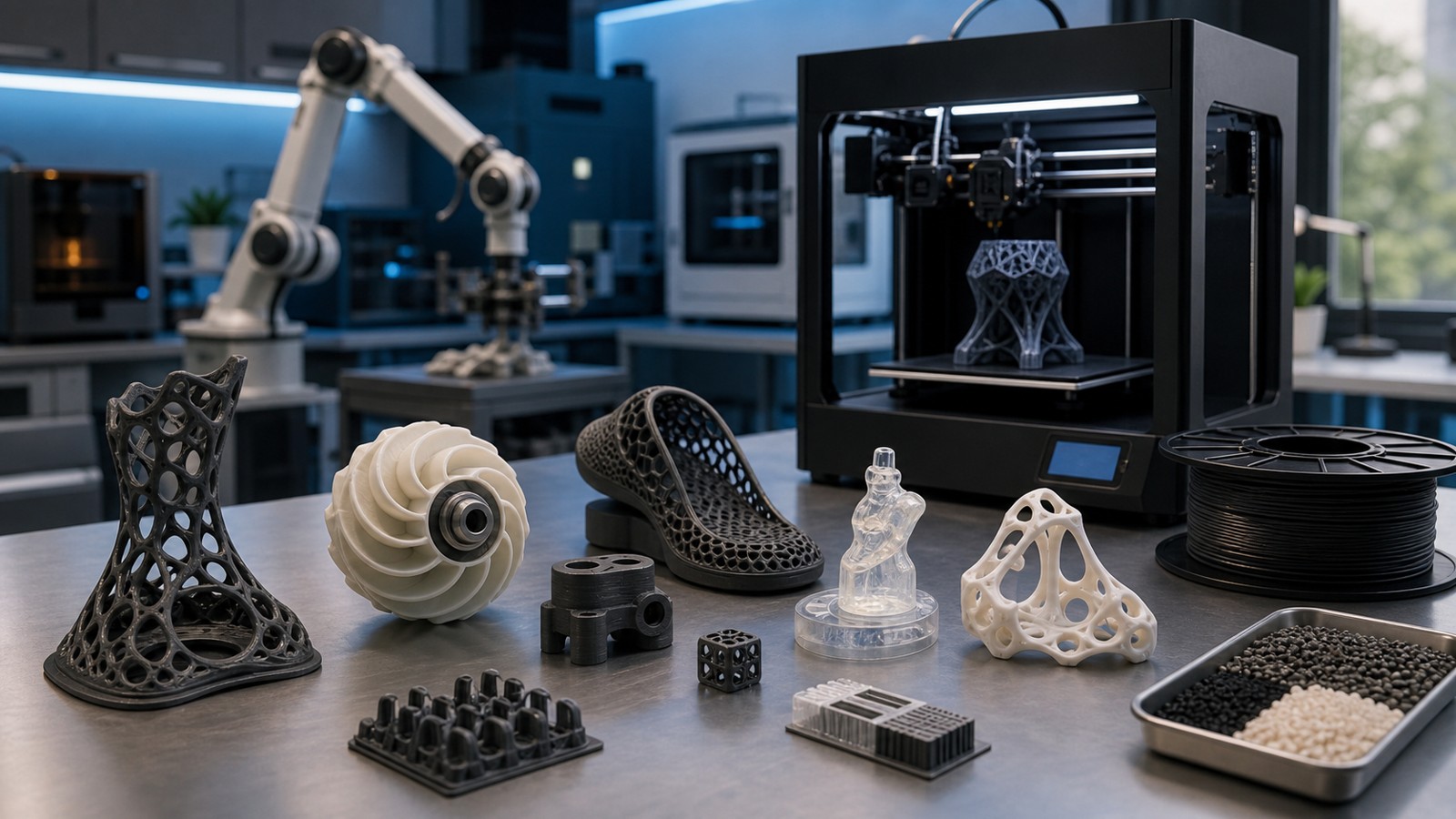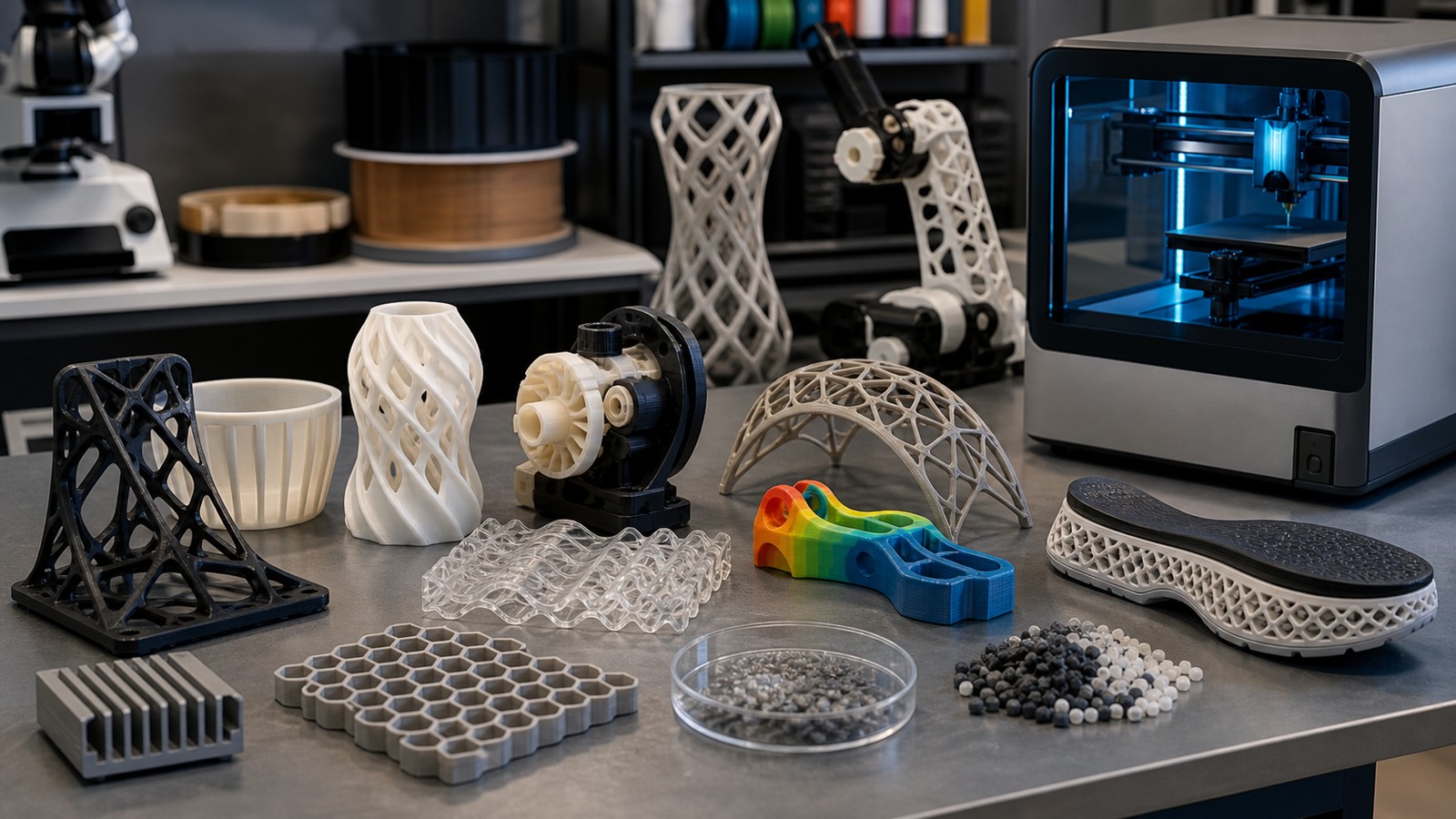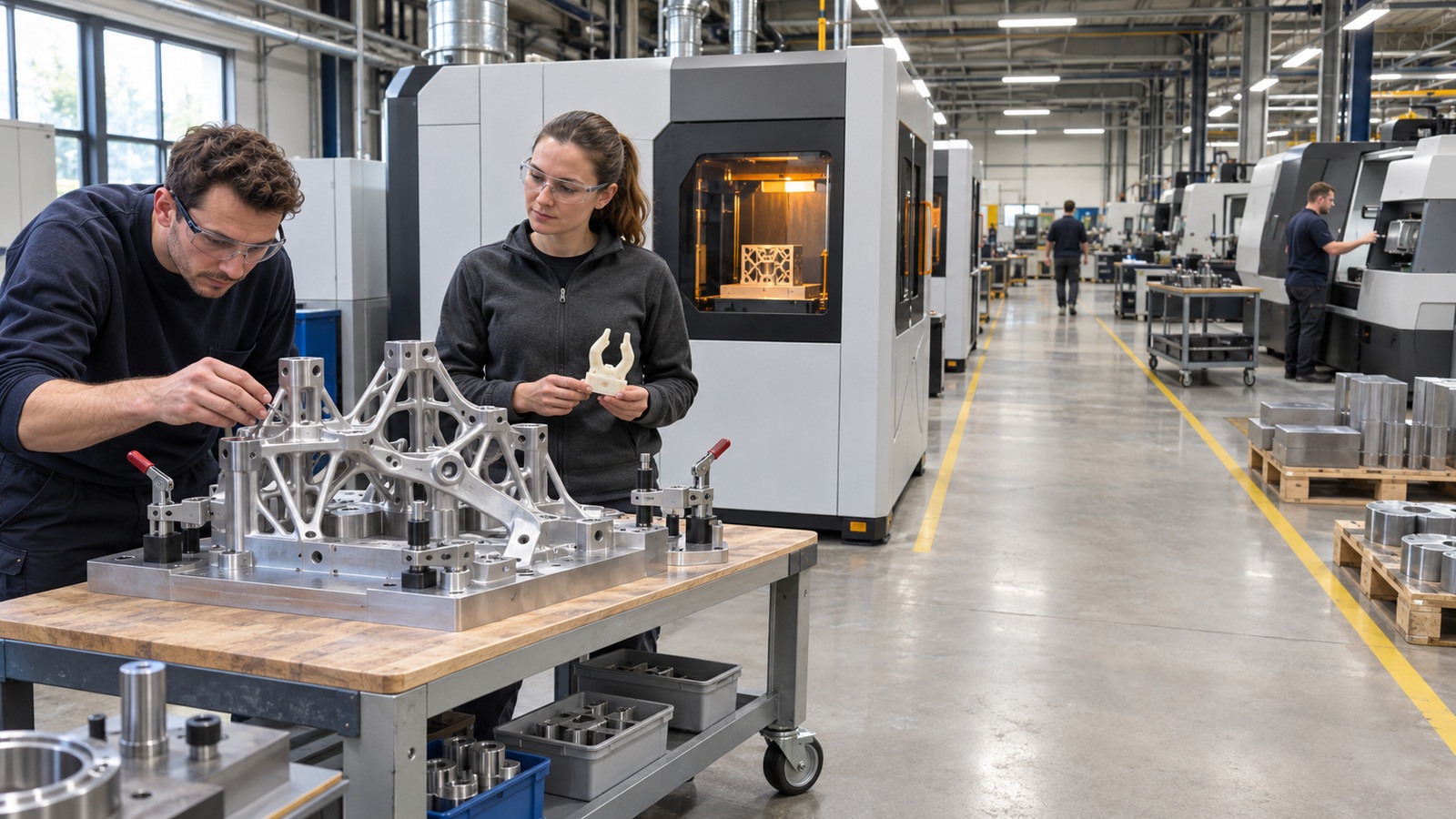
The Change Often Happens at a Particular Factory Operation
Watch where a robot picks up a part, where a worn industrial surface is restored, or where a designer receives the next physical prototype. Those operations reveal how additive manufacturing is changing production more clearly than an image of one printer replacing an entire assembly line. A lighter handling structure, a softer contact surface, or a nearby specialist service can change one important step while the surrounding factory continues to use established processes. This article follows documented examples from Germany, Denmark, the United States, Singapore, and an international production-service network. The reported figures belong to the dated company and institutional accounts cited below; they are not measurements of every factory or current worldwide output. The aim is to compare the work before and after adoption, including the people, finishing operations, and conventional processes that make the printed contribution useful.
A: The older comparison was against a conventional gripper; the further reduction used the preceding printed-gripper generation. They are different comparisons, not percentages to add.
A: No. Its large-scale printing uses granulated material, while laser powder bed fusion identifies a different forming route. Similar-looking process initials should not be read as the same machine mechanism.
A: No. The supplier account associates that figure with earlier hearing-aid-shell manufacture, before describing the later tooling application. It is not a gripper-cycle speed claim.
A: It means carbon-fiber-reinforced polymer. Here it describes the roof material being handled, rather than specifying the printed gripper’s formulation.
A: It means small and medium-sized enterprises. A particular programme defines its own eligibility; the abbreviation itself is not a universal numerical company-size threshold.
A: WAAM supplies metal wire to an arc-based process. Powder-fed laser cladding delivers powder into a laser-generated deposition region. These are different deposition arrangements, not interchangeable feedstock names.
A: A researcher works with the member company for a defined period, transferring technical know-how through its project. It is a people-and-development arrangement rather than simply the purchase of another printer.
A: Some work can be assigned outside internal production when available resources and demand do not align. The term concerns organizing production capacity, not just owning another file copy.
A: Destructive testing consumes or damages the specimen in examining its properties. Nondestructive methods examine selected characteristics without that deliberate destruction; each method still has its own scope.
A: It is a defined reference used to establish the location or orientation of other features. It need not be the most visually prominent edge of a printed object.
Manufacturers Gain Another Way to Organize Work
Additive manufacturing builds geometry by adding material according to digital data. Its industrial importance comes from the options that mechanism can create: tailored contact surfaces, complex internal shapes, shorter physical iterations, and alternatives to dedicated tooling for suitable quantities. A factory does not need the same option at every operation. Its useful starting point is a particular product feature or task that the existing route handles awkwardly.
The first change may occur in development. A team can produce a physical design, inspect how it fits an assembly, and alter a local feature before committing to more expensive tooling. This shortens the distance between a drawing and a conversation around an actual object. The prototype’s purpose still matters: seeing a connector opening and testing a loaded bracket are different activities, even when both involve an early printed part.
On an operating line, production aids offer another entry point. A holding fixture, robot contact, or inspection aid can be shaped around a specific movement or surface. NIST’s manufacturing overview places prototyping, customization, complex geometry and lower-volume production among additive manufacturing’s potential benefits. The cases below show how those broad possibilities become different local changes rather than one universal factory model.
BMW Changes the Roof-Handling Sequence in Germany
BMW’s May 2024 gripper report describes a Landshut tool that loads raw CFRP material into a press, rotates 180 degrees, and removes the finished roof. SLS produces its vacuum contacts and needle-gripper clamps, while large-scale printing supplies the shell and bearing structure. One handling arrangement therefore serves two operations.
A redesigned generation introduced in summer 2023 combined a printed shell and contacts with a topologically optimized cast-aluminium structure. BMW reported a further 25 percent reduction against the preceding gripper and said the M3 roof process could use one robot instead of three.
A Different Automotive Tool Has a Different Comparison
BMW’s October 2024 production overview also describes a Munich i4 floor-assembly gripper made through aluminium casting with a printed sand mold. Its reported roughly 30 percent weight reduction compares that tool with the previous conventional version. This is a separate application from the roof-gripper redesign, with a different reference tool. Treating the percentages as one combined reduction would obscure which physical arrangement changed.
Aerospace Shows Why Production Scale Changes the Inspection Work
In the United States, a 2021 Army account of additive manufacturing used GE’s LEAP fuel-nozzle production in Auburn, Alabama, to discuss industrialization. Its example concerns repeated manufacture of relatively small components. The account contrasts those builds with larger engine components, where the number of full parts available for destructive sampling is more limited.
Multiple small parts on a plate can support a different sampling plan from one large component accompanied by smaller coupons. The Army discussion explains that a coupon may not reproduce a full part’s geometry and thermal history. It identifies nondestructive evaluation and in-process monitoring as important areas of work for larger production applications. Changing component size therefore changes more than the required machine envelope.
The broader production lesson is that an inspection method belongs to the thing actually being made. A small repeated article offers different opportunities to examine variation from a large, slow build whose failure would consume a substantial production slot. This helps explain why industrial adoption involves manufacturing engineering alongside shape creation. The interesting transition is an entire production method becoming workable for its component, rather than a complex model simply reaching the end of a print.
WS Audiology Changes Contact With Tiny Molded Parts
A 3D Systems case from WS Audiology in Lynge, Denmark describes injection-molded parts as small as 8 by 3 millimeters. Suction handling could lose orientation or grip, while metal grippers could leave marks. The tooling team adopted Figure 4 printing with rigid and rubber-like resins to change those contacts.
The report quotes gripper availability of one to two days and annual activity of about 200 grippers, 100 jigs and fixtures, and more than 500 prototypes. Those are different output categories within the reported tooling operation. They describe access to varied production aids rather than the speed of molding each hearing-device part.
Compare the Two Handling Problems Directly
BMW’s example centers on moving a large load through a press-handling sequence; the Danish example centers on retaining tiny parts in the right orientation without marking them. A lighter load and a more suitable contact are different improvements. In another factory, the corresponding investigation would start with reach, payload and movement in the first situation, or contact location, orientation and surface condition in the second. That is a more practical comparison than asking which company has the faster printer.
A Production Tool Combines Different Physical Functions
A handling tool has a machine attachment, a structure carrying forces, and surfaces that meet the workpiece. Those regions do different jobs. The mounting pattern connects the tool to its equipment, the body holds its shape, and the contacts determine where force reaches the product. Treating them separately makes a proposed change easier to understand.
The contact might need a complex contour while a mounting face needs a simple machined reference. A softer surface may protect the product without being suitable for the whole load-bearing structure. Combining materials and forming methods lets the designer assign each region an appropriate role. The resulting tool is an assembly of functions, rather than a contest to print every piece.
Loads also travel through that arrangement. The distance between the held object and the machine attachment affects the moment applied to the supporting structure. A broad contact, a long reach and a compact central support do not produce identical force paths. This explains why shape and placement can matter alongside the amount of material removed.
Onsite Repair Moves the Manufacturing Route to the Asset
Siemens Energy’s onsite additive-repair description gives a concrete journal-restoration sequence: evaluate the condition, pre-machine the affected rotor area, apply laser cladding, finish-machine the original diameter, and perform nondestructive testing. The deposited metal is one stage in restoring the working surface. Final turning and inspection remain visible parts of the route rather than disappearing behind the additive label.
Moving suitable equipment to an asset can change the logistics of a repair. An operator may be dealing with a large installed component, transport restrictions, or a scheduled outage instead of ordering a small new part from a remote printer. The repair plan must connect access at the work site with preparation, deposition and finishing. This creates a different manufacturing service from shipping a complete replacement, while leaving the component’s condition and repairability central to the decision.
Singapore Builds Capability Through People and Process Development
Singapore’s A*STAR describes an ARTC secondment at mold maker Omni Mold, which began its T-UP project in February 2021. The company had invested in additive technology and wanted a more scientific, cost-effective approach. An ARTC engineer worked on a new-material qualification procedure connecting material characterization, laser parameters and post-processing.
The practical change is the connection between a company’s equipment and a method its team can use. A new material does not arrive with every local production choice already resolved. Working through characterization and processing gives the team a route for introducing candidates rather than relying only on a machine demonstration. That kind of knowledge transfer can remain valuable after a temporary adviser leaves.
The wider ARTC industrialisation programme spans design development, material performance and process optimization. These activities place geometry, feedstock behavior and manufacturing requirements in the same development effort. For a regional ecosystem, shared expertise can be as important as the availability of another machine. It lets firms investigate an application through a broader set of tools and skills.
Production Services Connect Several Continents
Materialise’s 2025 annual filing lists manufacturing service centers in Belgium, the Czech Republic, Germany, Poland, Japan, Brazil and the United States. It also describes in-house use of several additive technologies and subcontracting for certain other processes or capacity balancing. This shows a production business combining locations and routes, rather than a single standardized printer duplicated everywhere.
For a customer, that network changes how specialized capacity can be accessed. The useful conversation concerns the service needed at a given location: geometry preparation, a particular manufacturing route, finishing or inspection. A sales presence and a production facility perform different functions. Understanding the actual service arrangement makes the geographic story concrete without assuming that a nearby office can manufacture every item in a catalog.
Finishing Still Determines the Delivered Object
Printing does not remove the work between the build and the next factory operation. A machined seat may need to meet a bearing, a resin contact may need its specified cure, and a repaired journal needs its final surface and inspection. Those steps give the output the condition that the next operation relies on. Planning them alongside the build prevents an impressive printing rate from becoming a queue of unfinished work. The relevant production unit is the usable tool or component moving forward, with the required people and equipment available to finish it.
Conventional Manufacturing Becomes Part of the New Route
Casting, molding, machining, forming and joining retain their own strengths. A stable, high-volume product can still justify dedicated tooling, while a customized contact or complex component may favor an additive route. Some applications combine these choices inside the same production chain. The question is where a different method removes a constraint, rather than whether one technology should win every operation.
This is particularly useful when examining a proposed redesign. Separate the function that needs to change from the rest of the product: a contact shape, an accessible passage, a local worn region, or a feature that benefits from rapid iteration. Consider the process that forms that feature and the work needed before it enters use. The result may be a mixed route that preserves efficient conventional operations while changing the part of the chain that was holding development or production back.
Look for the Specific Work That Changed
Across these examples, worldwide adoption follows different needs: handling load, small-part contact, production inspection, asset repair, development knowledge and access to specialized services. The comparison becomes clearer when each need is tied to a physical operation and an identified organization. A manufacturer considering its next application can begin in the same place: identify the troublesome step, explain what a different geometry or route would change, and include the finishing work needed afterward. That is how additive manufacturing becomes part of making and maintaining products, rather than remaining an isolated display of printable shapes.