Read the Initials Before You Read the Promise
A supplier might offer an SLS part from a CAD file, attach a TDS, and recommend a QC check before delivery. Every abbreviation belongs to the same conversation, but each describes a different thing: a manufacturing method, a design tool, a document, or an inspection activity. Learning that distinction is more useful than memorizing an alphabetical wall of initials. The most important 3D printing acronyms help you interpret printer specifications, identify materials, exchange files, understand setup advice, and ask better questions about finished parts. Some are formal technical shorthand, some are product names, and others are everyday abbreviations borrowed from electronics or manufacturing. This guide groups them by where you encounter them and explains what an expansion can establish, what it leaves unresolved, and when you should ask the writer to define the term before making a decision.
A: Usually they refer to the same general filament-extrusion approach; inspect the actual machine.
A: No. USB Type-C identifies a cable and connector specification, while USB 3.2 identifies a data-transfer specification. The USB-C connector name alone does not specify that data capability.
A: GPa means gigapascal and MPa means megapascal; one gigapascal equals one thousand megapascals. Put values into consistent units before comparing the same property.
A: No; safety information and performance data serve different purposes.
A: No; ask which checks and acceptance criteria were applied.
A: Its results depend on loads, constraints, material assumptions, and validation.
A: No. AMF names Additive Manufacturing File Format, while 3MF names 3D Manufacturing Format. Check the actual exchange format requested by the recipient.
A: It means revolutions per minute, a rotational speed. It describes the fan turning rather than a nozzle's linear travel or the length of filament delivered.
A: Yes. Computed tomography is a common inspection meaning, but a local document can define another use. Read its legend before interpreting the letters.
A: It can include both when they belong to the assembly. A bill of materials describes the required components, not only the model files sent to a printer.
Quick Lookup for Frequently Used Initials
Looking for one term? Use these alphabetical shortcuts to its explanation: 3MF, ABS, AM, CAD, DED, DLP, FDM and FFF, MJF, PA and PETG, PID, PLA, QC and SDS, SLA, SLS, STL, TDS, TPU, and UV. The sections group related terms so their differences remain visible. The five numbered reference boxes provide additional expansions, including less frequent hardware and material abbreviations. Start with the full wording, then read the short example that explains where you will encounter it.
AM, FFF, FDM, and MEX Establish the Process
AM means additive manufacturing, the broad field of making objects by adding material according to digital geometry. It does not identify a particular machine or material. A term such as SLA narrows the discussion to a printing technology, while PLA identifies a polymer family and TDS identifies a technical data sheet. Mixing those roles creates misleading comparisons, such as asking whether a file format is stronger than a printing process. First identify the kind of thing the abbreviation names, then consider what further information is needed.
Abbreviations also vary between sources. A technical document may use one preferred designation while a shop uses a familiar historical name for a related process. Do not assume that every difference in initials represents a completely different physical mechanism. The NIST overview of additive manufacturing technologies is a useful starting point for locating major process families before interpreting more specific terms in a quotation.
FFF expands to fused filament fabrication, while FDM expands to fused deposition modeling. In ordinary desktop-printer discussions, both commonly refer to equipment that feeds thermoplastic filament through a heated nozzle and deposits successive paths. Their wording differs, and FDM has a commercial trademark history, but the practical question remains how the particular system handles the required material and geometry. A description such as FFF with PLA names the forming method followed by the material; those are two different pieces of information.
Read the surrounding specification for nozzle capability, build environment, feed arrangement, and supported materials. Two filament printers can share the same process label yet differ greatly in practical performance. For example, a listing may identify a direct-drive feed arrangement separately from its FFF process name. The first describes where filament is driven; the second describes how the object is formed.
Industrial extrusion descriptions may use the broader family label MEX, meaning material extrusion. That family can include feedstocks beyond ordinary spooled plastic. Knowing the broader term helps you recognize why pellet extrusion and some paste-based systems appear near filament machines in a technical classification. The initials organize a mechanism; they do not erase the substantial differences between individual implementations.
SLA, DLP, and LCD Describe Different Parts of Resin Printing
SLA commonly means stereolithography and is widely associated with light-cured resin printing, particularly laser-based systems. DLP means digital light processing and describes a projection approach used by suitable printers. LCD means liquid crystal display; in a masked resin printer, an LCD controls which regions receive exposure. A description can therefore combine resin printing with an LCD component without describing a liquid called LCD. Read whether the writer is naming the formation process, an optical component, or a product family. The distinction explains why replacing a screen and choosing a resin are different setup decisions, even when the same printer description mentions both.
SLS, LPBF, MJF, and DED Need Their Context
SLS stands for selective laser sintering and commonly appears in polymer powder-bed discussions. LPBF means laser powder bed fusion and is widely used when describing laser-based metal powder processing. MJF is HP’s Multi Jet Fusion technology name, referring to a particular powder-based polymer production approach. These names help identify how the part forms, but a comparison still needs the actual material, machine, and delivered condition. A nylon component and a metal component should not be compared using process initials as if their service behavior were otherwise interchangeable.
DED expands to directed energy deposition, in which material is supplied to a region where focused thermal energy joins it to the underlying material. WAAM means wire arc additive manufacturing, a wire-fed arc-based approach discussed within metal deposition. Such systems can be useful for larger structures or adding material to existing components, often with machining afterward. A reader moving from desktop printers into industrial additive manufacturing should therefore expect initials to describe a production chain rather than a finished component ready for service.
Expand the Codes on Filament Labels
PLA means polylactic acid. ABS expands to acrylonitrile butadiene styrene, while PETG identifies glycol-modified polyethylene terephthalate. These are polymer designations, so they belong in the material part of a specification rather than the process column. You may see several of them offered for the same filament printer. A suffix can add another ingredient: CF commonly indicates carbon fiber in filament labeling, as in a carbon-fiber-filled base polymer. Read the complete product designation rather than expanding only its most familiar letters.
TPU means thermoplastic polyurethane, and TPE means thermoplastic elastomer, a broader category that includes TPU and other elastic material families. PA stands for polyamide, commonly called nylon, while PC stands for polycarbonate. These labels describe chemistry at different levels of specificity. A TPU product can also be described as a TPE without being two separate materials. Numerical grade identifiers and additional suffixes can narrow a designation further, so retain them when asking a supplier about a particular spool.
ASA means acrylonitrile styrene acrylate, PVA commonly means polyvinyl alcohol in soluble-support listings, and PEEK means polyetheretherketone. Learning these expansions helps connect a label to its technical documentation; it does not require a beginner to use every material in the list. A purchase description might distinguish a model filament from a PVA support spool, giving the two products different jobs in the same build. Keep the actual product name alongside the abbreviation so that storage, machine compatibility, and handling instructions can be found for the supplied formulation.
CAD, CAM, CAE, and FEA Belong to Different Design Tasks
CAD means computer-aided design and refers to tools used to create or modify the model. CAM means computer-aided manufacturing and concerns preparing manufacturing operations, often associated with machining workflows. CAE means computer-aided engineering, while FEA means finite element analysis, a numerical approach used to study behavior under defined assumptions. These tools can cooperate on the same project without doing the same job. An attractive CAD model does not prove a structural requirement, and an FEA result depends on loads, constraints, material representation, and validation. DfAM, design for additive manufacturing, describes designing with the capabilities and restrictions of the intended additive route in mind rather than simply exporting an arbitrary shape to a printer.
Control and Hardware Initials Explain Setup Advice
PID means proportional-integral-derivative, a control approach encountered in printer temperature regulation. PWM means pulse-width modulation, which controls a suitable electrical output through switching. MCU means microcontroller unit, while PSU means power supply unit. A PID discussion concerns control behavior; a PSU discussion concerns a physical electrical supply. Knowing the expansions helps identify which part of the printer a support instruction is discussing without confusing a software-controlled target with a replacement hardware specification.
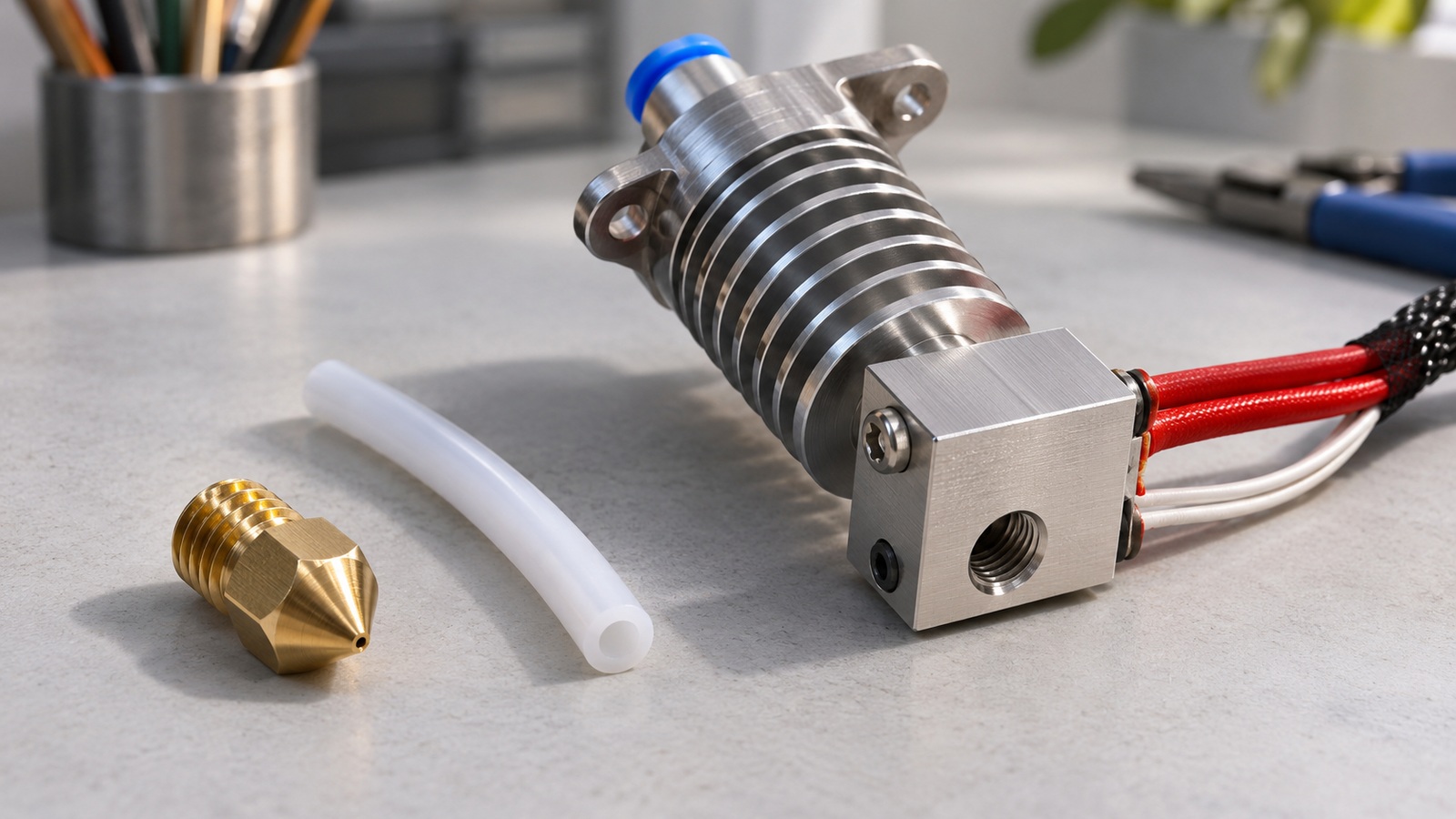
USB means Universal Serial Bus, SD means Secure Digital, and LED means light-emitting diode. UV means ultraviolet, while PTFE expands to polytetrafluoroethylene, a polymer used in suitable guide tubing and other components. These terms name different things: interfaces, storage media, light-related concepts, and a material. A printer may use an SD card to receive a job and an LED to indicate a state; neither abbreviation describes the mechanism joining its layers. In a resin machine, UV describes part of the exposure discussion rather than a separate file format or material brand.
Use model-specific instructions when an abbreviation appears inside a service procedure. A command involving PID can differ from a menu option that simply selects a printing temperature, and a PSU is not something to replace by matching a familiar three-letter label. Identify the assembly or control function being discussed before taking action. The manual supplies the supported procedure; the glossary helps you recognize its subject. This keeps the lookup useful without turning it into a collection of transferable electrical or firmware settings.
STL, OBJ, STEP, and 3MF Identify the Handoff
File labels tell you which representation is being exchanged. The Library of Congress lists STL as STereoLithography, a familiar triangular surface format. OBJ is a mesh-format identifier; it should not be invented into an engineering process acronym. STEP expands to Standard for the Exchange of Product Model Data, as described by NIST. It is widely used for engineering product-data exchange. These labels concern a digital handoff rather than the plastic, resin, or metal in the eventual part.
3MF means 3D Manufacturing Format. The 3MF Consortium specification defines units and other manufacturing-model information, while AMF names the separate Additive Manufacturing File Format. Ask which format the receiving application supports instead of assuming similar initials identify the same package. A supplier requesting STEP for CAD work and a printer operator requesting a manufacturing mesh may be asking for different representations of the same design. Confirm the requested output before exporting, and keep the original editable model separately from that exchange copy.
Read Documents and Inspection Initials in Context
A TDS is a technical data sheet, usually presenting product properties and processing information, while an SDS is a safety data sheet describing hazards and handling information for the product. They serve different purposes and neither should be substituted for the other. QC means quality control and concerns checking outputs against requirements. QA means quality assurance and addresses the processes used to provide confidence that requirements will be met. Ask which specific checks and records are included rather than accepting either label as proof of a good part.
NDT means nondestructive testing, while CT can mean computed tomography in an inspection discussion. CMM means coordinate measuring machine, used for suitable dimensional measurements, and GD&T means geometric dimensioning and tolerancing. These labels identify tools or specification systems, but the relevant method, acceptance criteria, and operator capability remain important. A statement that a part received inspection is incomplete unless it explains what was examined and what result was acceptable.
BOM means bill of materials, a structured component list for an assembly. It can include printed parts, bought-in screws, inserts, and other items needed to put the product together. Autodesk’s BOM explanation distinguishes assemblies, subassemblies, and purchased items within that structure. A folder containing three model files is therefore not automatically a complete BOM for the object shown in its assembly photograph. The abbreviation tells you to look for component identities and quantities rather than another shape file.
Consider an illustrative quotation for an SLS PA component supplied from a CAD model, with a TDS and a dimensional QC report. SLS describes the manufacturing technology, PA identifies the polymer family, and CAD describes the source-modeling context. The TDS is a product-information document, while the QC report concerns the checks performed on the delivered output. Expanding the terms turns a string of initials into an understandable account of making, specifying, and checking a part. You can then identify any detail that the quotation still needs, such as the exact PA grade.
Keep unusual abbreviations defined where a project introduces them. CT commonly identifies computed tomography in an inspection discussion, but a company’s own schedule might use those letters differently. Read the legend or ask the writer before interpreting the figure. A small project-specific list is useful when several people share documents, especially if their departments use overlapping shorthand. The goal is clear communication: recognize whether the initials describe a process, material, tool, component, file, or record, then read the surrounding sentence for the intended meaning.