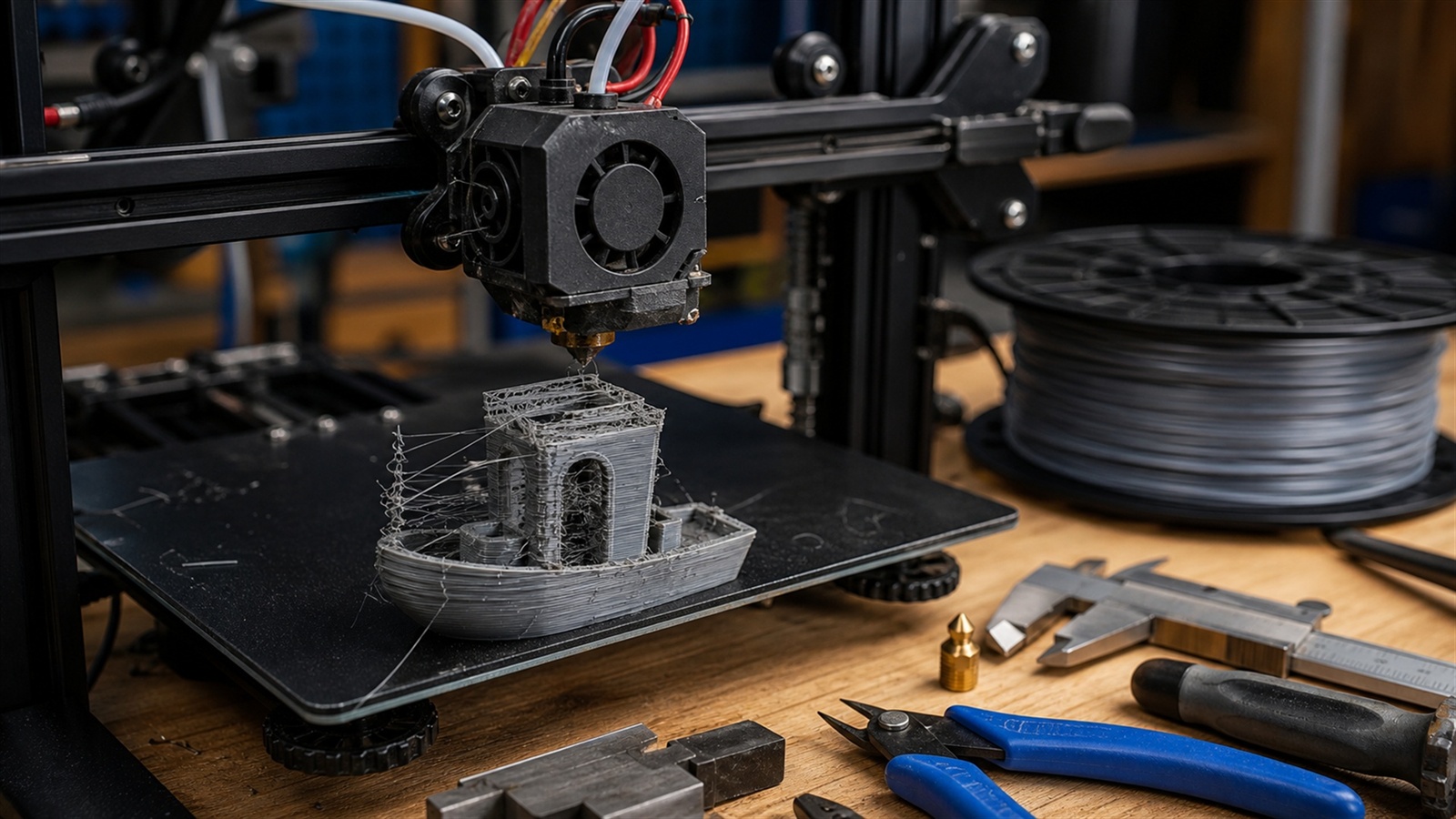
Fused Deposition Modeling, more commonly known as FDM, is often the first 3D printing technology people encounter. At first glance, it looks surprisingly simple: a machine pulls plastic from a spool, melts it, and draws shapes on a build plate. But underneath this seemingly minimal process lies a complex interplay of thermodynamics, motion systems, firmware coordination, and materials science. To understand how FDM truly works, we need to look deeper—inside the nozzle, behind the motors, beneath the gantry, and into the software where each print begins. This is not just a machine pushing hot plastic. It is an orchestrated technological dance. FDM works because every component, from the filament tension to the micro-steps of the motors, is calibrated to transform a digital blueprint into a tangible, layered creation. In this guide, we will examine everything that makes this technology possible. Each section highlights a critical part of an FDM printer’s operation: the extrusion system, the thermals, the mechanics, the electronics, and the software. Whether you’re a beginner, an engineer, or a maker who simply wants a deeper understanding, this exploration reveals how remarkably sophisticated FDM printing truly is.
A: Match the model, material, settings, and finish plan to the purpose of the print.
A: Bed leveling, surface cleanliness, nozzle height, temperature, and material condition are the usual suspects.
A: No. Slower speeds can improve detail, but heat buildup and profile balance still matter.
A: Use the right material, more walls, smart orientation, enough infill, and realistic load testing.
A: Temperature, retraction, travel moves, moisture, and material type all contribute.
A: Diagnose poor first layers, weak parts, stringing, warping, and rough surfaces before buying parts.
A: Very important; it shows toolpaths, supports, layer changes, and possible weak spots before printing.
A: First layers, simple calibration prints, support cleanup, and basic material profiles.
A: Clean orientation, tuned settings, good material handling, and careful support removal, sanding, painting, fitting, and practical testing.
A: It is most useful for makers who want cleaner prints and fewer wasted attempts.
Inside the Heart of the Machine: The Extruder System
The extruder is the engine that drives the entire FDM process. It is responsible for feeding filament consistently, melting it with precision, and depositing it in controlled paths. Most FDM printers use either a direct-drive or Bowden setup, each with unique strengths that influence print quality and speed. In a direct-drive system, the filament is pushed from a motor located near the hot end, giving superb responsiveness and control. This makes flexible materials and complex extrusion patterns easier to achieve. Bowden systems, on the other hand, place the drive motor away from the print head, reducing weight and allowing faster, smoother motion—especially beneficial for large, fast-printing machines. Filament must be fed at a consistent rate. This requires pressure between the extruder gear and the filament, and the optimal grip varies by material.
Harder filaments glide differently than soft ones, and fiber-reinforced materials require even more robust feeding systems. But feeding is only the beginning. Once filament enters the hot end, it experiences carefully managed heating zones. The lower “melt zone” liquefies the filament, while the upper “heat break” keeps heat from creeping upward. Without this separation, filament would swell prematurely and jam. The nozzle, often made from brass or hardened steel, determines the thickness of each printed line. A 0.4 mm nozzle is the standard, balancing speed and detail, but larger or smaller nozzles reshape the printing experience entirely. Every centimeter of filament that enters the hot end emerges as a precisely extruded line—this is the beating heart of FDM.
The Science of Heat: How Temperature Controls Everything
Temperature is arguably the most critical element in the FDM process. Every filament type has an ideal temperature range for extrusion, and even small deviations can lead to issues like stringing, under-extrusion, or weak layer adhesion. PLA melts easily and prints best with ample cooling. ABS requires higher temperatures and controlled airflow to prevent cracking. PETG thrives with moderate cooling and a slightly sticky flow. Nylon absorbs moisture readily and demands high heat for strong, smooth extrusion.
The hot end contains a heating cartridge that warms the metal block to a precise degree, and a thermistor constantly monitors this temperature. Modern printers use PID tuning—a method of adjusting variables in real time—to keep the temperature stable. Too much fluctuation and layers will become inconsistent.
The build plate also plays a major role. Heated beds help reduce warping, soften the first layers, and create a better bond between the print and the surface. Materials like ABS and Nylon practically require high bed temperatures, while PLA typically needs only light heating. Some advanced printers even use fully enclosed chambers to maintain consistent environmental temperatures, preventing warping at the higher end of material performance.
Motion Control: The Precision Behind Every Layer
While the extruder controls the flow of material, the motion system defines where that material goes. Modern FDM machines typically use Cartesian, CoreXY, or Delta configurations. Each has its own handling characteristics, but they all rely on similar principles of precision movement. Stepper motors, guided by microstepping instructions, move the print head and build plate in controlled increments as small as fractions of a millimeter.
Smooth linear rails, belts, pulleys, and lead screws translate the motors’ motions into fluid movement across the X, Y, and Z axes. Any slight imperfection—belt tension, rail lubrication, frame rigidity—affects print quality. This is because FDM printing is cumulative: every layer builds on the last. If the head shifts mid-print, even by a fraction, artifacts and inaccuracies appear in the final object. The print head must move at just the right speed. Move too fast and corners may distort. Move too slow and blobs or overheating may occur. Motion control is where mechanical engineering meets artistic refinement, as every motion becomes a brushstroke in the finished piece.
Firmware and Electronics: The Invisible Intelligence
Although 3D printers look mechanical, the electronics are the quiet brains behind the operation. A mainboard governs everything: motors, heaters, sensors, fans, and display interfaces. It interprets G-code—the language of 3D printing—and converts instructions into physical movement and thermal adjustments.
Firmware such as Marlin, Klipper, or proprietary systems determines how the printer behaves. It controls acceleration, jerk, calibration routines, safety shutoffs, and thermal monitoring. Advanced systems even calculate pressure buildup inside the nozzle and adjust extrusion accordingly.
Stepper drivers convert digital instructions into finely tuned electrical signals that move the motors. The quality of these drivers affects how quiet, smooth, and accurate the printer feels. Some modern systems use silent stepper drivers, which dramatically reduce noise and improve resolution. Together, the firmware and electronics give the machine the ability to follow complex paths with precision and safety. They ensure that every heating coil, fan, and motor is perfectly choreographed.
Understanding Slicing: Where Every Print Begins
Before a print ever touches the machine, it begins in slicing software. This is where a 3D model is translated into the layers, toolpaths, and extrusion commands the printer will follow. Slicing software determines layer height, infill density, wall thickness, supports, retraction settings, and dozens of other parameters. A slicer is more than a tool—it is the artistic lens through which the user controls how the final print will look and behave. The slicer divides the object into horizontal slices and generates the exact path the nozzle will follow for each layer.
It determines how fast the printer will move, when it will retract filament, and how it handles intricate geometries. Small settings, like adjusting first layer height or fine-tuning retraction distance, can drastically change the outcome. Different materials require different slicing profiles. ABS may need slower speeds and thicker layers. PLA benefits from controlled cooling and sharp retractions. PETG performs best with smooth movements and minimal retraction. Fine-tuned slicing is the difference between a good print and a masterpiece.
First Layer Mastery: Where Every Print Succeeds or Fails
The first layer is the foundation of a successful print. If it doesn’t stick properly, the rest of the print is doomed. Achieving a perfect first layer involves bed leveling, correct nozzle distance, and optimal bed adhesion. Modern printers use mesh leveling and sensors like BLTouch or inductive probes to map the bed surface and compensate for microscopic irregularities. Temperature also plays a huge role here. Print surfaces such as PEI sheets, textured plates, and glass beds interact differently with each material. PLA loves smooth surfaces at moderate heat, while materials like PETG grip strongly and require delicacy to avoid permanent bonding. A flawless first layer should look smooth, slightly squished, and consistent. When this is achieved, the rest of the print can soar confidently upward, layer by layer.
Layer-by-Layer Architecture: Building a Model in Three Dimensions
FDM printing constructs objects additively. Each layer cools and solidifies before the next one arrives, creating a chain of thermal and mechanical connections. The strength of the final object depends heavily on how well these layers fuse. If the nozzle is too cool, layers won’t bond well and the print may split. If it’s too hot, details blur and edges soften.
Infill patterns add structural support inside the object, and wall thickness defines its perimeter strength. Minimal infill is ideal for lightweight decorative items, while dense infill or strong patterns like gyroid help functional components withstand demanding loads.
Supports allow complex overhangs to print successfully, though their placement and removal require strategy. Slicers analyze geometry to determine where supports are necessary, but experienced users often fine-tune them manually. Each layer is a story of physics: cooling rates, fluid dynamics, mechanical stresses, and precision timing. Together, they form the complete model.
The Role of Cooling and Airflow
FDM printing relies on controlled cooling. PLA needs active cooling to achieve crisp edges and fine details. ABS and Nylon, however, should cool slowly to prevent warping or layer separation. The cooling fan is responsible for regulating this process, and its behavior varies depending on the material and print stage.
Overhangs, bridges, and thin details benefit the most from strategic airflow. Cooling modifies the thermal behavior of molten filament, locking it into shape. However, too much airflow on high-temperature materials can ruin a print. Understanding how cooling works is key to optimizing print clarity and structural performance.
Print Stability and Machine Calibration
Behind every beautiful print lies a calibrated machine. Belt tension must be consistent. Rails must be lubricated and aligned. Nozzles must be clean and unobstructed. Even the filament spool must unwind evenly to prevent sudden tension spikes. Regular calibration practices—such as checking steps-per-mm, aligning the gantry, and verifying temperature accuracy—ensure long-term stability. This maintenance mindset is part of what separates casual users from confident creators.
Why FDM Remains the Most Popular 3D Printing Method
FDM’s dominance is not an accident. It is affordable, accessible, versatile, and continually evolving. With a single machine, you can print engineering-grade parts, artistic sculptures, cosplay armor, robotics prototypes, and household tools. The ability to swap materials, tune settings, and modify hardware makes FDM a unique platform for creativity and engineering innovation.
At its core, FDM is a powerful combination of mechanical precision, thermal science, and digital control. The simplicity seen from the outside hides an intricate process inside—a process that brings imagination into reality one layer at a time.
A Technology Built on Precision and Possibility
Understanding how FDM 3D printers work reveals just how astonishing this technology truly is. It is a finely balanced system where heat, motion, pressure, and software come together in perfect harmony. Every print is the result of hundreds of tiny decisions, from layer height to temperature tuning, that determine how the final object looks and behaves.
When you grasp the mechanics inside the machine, you gain not just appreciation—but control. You can troubleshoot issues more easily, tune your prints for perfection, and design models with greater confidence. From the moment filament enters the extruder to the final cooling of the top layer, FDM 3D printing is a marvel of engineering precision and creative empowerment.
This deep dive into the technology is only the beginning. The more you explore, the more this incredible process will continue to inspire new ideas, new experiments, and new creations.
Practical Next Steps
Before applying this topic to a real print, use the following checks to connect the idea to a specific part, material, printer, and workflow.
- Start with bed adhesion, nozzle temperature, cooling, and material dryness before changing complicated slicer settings.
- Use wall count, orientation, and infill pattern together when strength matters.
- Test tolerances with a small calibration part before printing hinges, clips, threads, or assemblies.
- Treat filament choice as a design decision: PLA, PETG, ABS, TPU, and nylon solve different problems.
FAQ
What controls FDM print strength most?
Material, layer orientation, wall count, nozzle temperature, cooling, and part geometry usually matter more than infill percentage alone.
Why do FDM prints fail on the first layer?
First-layer failures usually trace back to bed leveling, dirty build surfaces, incorrect nozzle gap, temperature, speed, or weak bed adhesion.
Which filament should beginners start with?
PLA is usually the easiest starting point, while PETG, ABS, TPU, nylon, and composites require more specific printer setup and handling.
Sources and Further Reading
Use these references to verify terminology, process limits, material behavior, and design guidance related to this topic.