
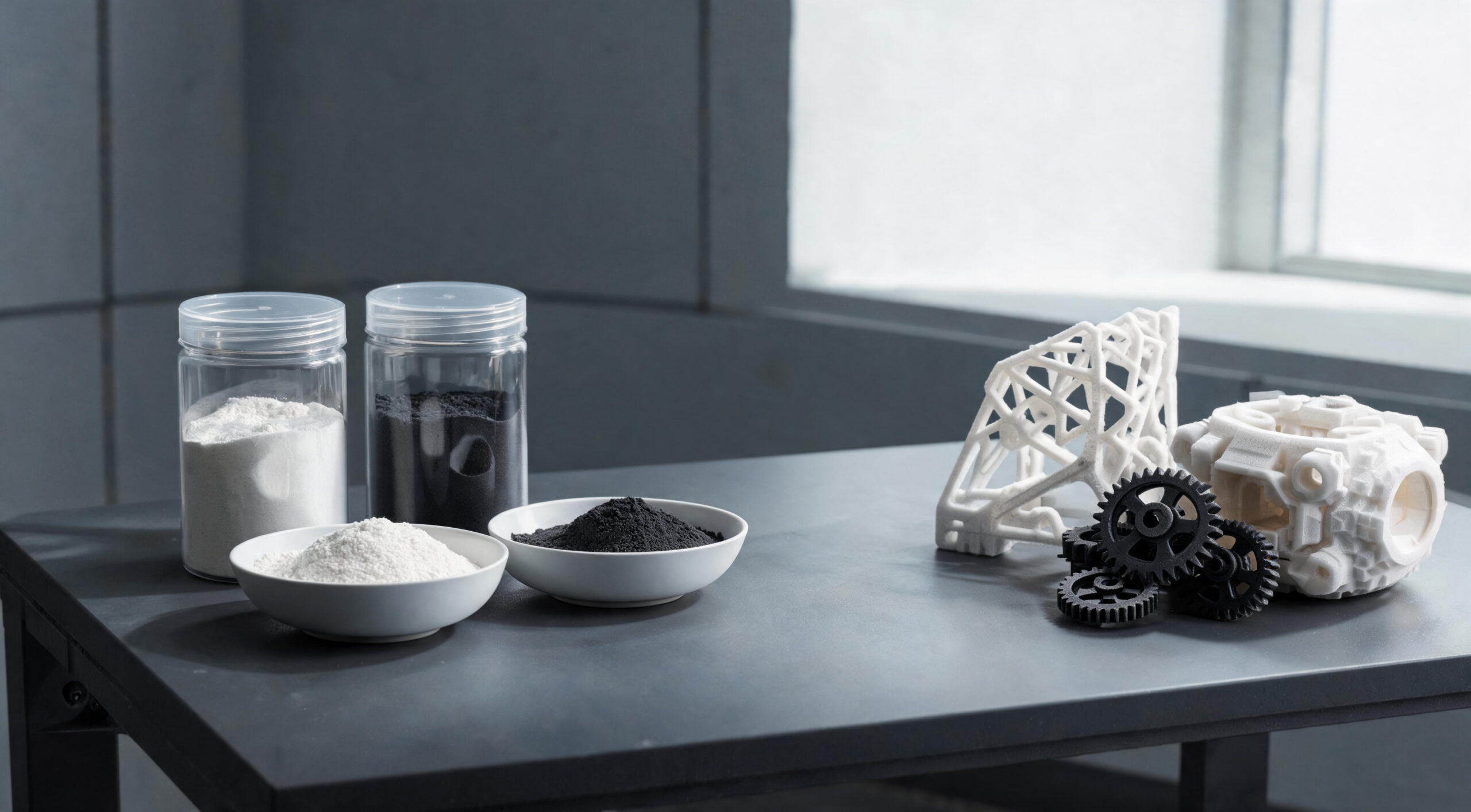
Why Nylon Powder Matters in SLS 3D Printing
Selective Laser Sintering is one of the most powerful technologies in additive manufacturing, but the printer itself is only half the story. The real magic happens in the powder bed. Every layer, every curve, every hinge, every bracket, and every production-ready component begins as a field of fine nylon particles waiting for the laser to bring them to life. Nylon powder is the foundation of most SLS 3D printing workflows because it offers a rare balance of strength, flexibility, durability, and repeatability. The right powder can turn a digital model into a tough mechanical part. The wrong powder can lead to weak fusion, poor surface quality, warping, or inconsistent performance. For engineers, makers, product designers, and manufacturing teams, understanding SLS nylon powders is one of the most important steps toward better prints.
A: Match the model, material, settings, and finish plan to the purpose of the print.
A: Bed leveling, surface cleanliness, nozzle height, temperature, and material condition are the usual suspects.
A: No. Slower speeds can improve detail, but heat buildup and profile balance still matter.
A: Use the right material, more walls, smart orientation, enough infill, and realistic load testing.
A: Temperature, retraction, travel moves, moisture, and material type all contribute.
A: Diagnose stringing, warping, weak layers, clogs, and moisture bubbles before buying parts.
A: Very important; it shows toolpaths, supports, layer changes, and possible weak spots before printing.
A: First layers, simple calibration prints, support cleanup, and basic material profiles.
A: Clean orientation, tuned settings, good material handling, and careful support removal, sanding, painting, smoothing, and part testing.
A: It is most useful for makers matching material behavior to the job instead of only the color.
What Makes Nylon So Popular for SLS Printing?
Nylon is widely used in SLS 3D printing because it behaves beautifully inside a powder bed fusion system. It can be formed into fine powder, spread into thin layers, heated with precision, and fused into durable parts without requiring support structures. That combination makes it ideal for complex geometries that would be difficult or impossible to create with traditional manufacturing.
Nylon also delivers practical real-world performance. It can resist impact, tolerate repeated handling, provide useful flexibility, and hold enough dimensional accuracy for functional prototypes and end-use components. From snap-fit housings to drone parts, robotics brackets, medical devices, jigs, fixtures, and consumer products, nylon powder gives SLS printing its industrial reputation.
PA12 Nylon Powder: The All-Around Standard
PA12 is the most common and widely trusted nylon powder for SLS 3D printing. It is often the first material beginners encounter and the material many professionals continue using for everyday production. PA12 offers strong dimensional accuracy, reliable printability, good chemical resistance, and a smooth enough surface finish for many engineering and consumer applications. The appeal of PA12 is its balance. It may not be the toughest nylon, the most flexible nylon, or the most heat-resistant nylon, but it performs well across a broad range of projects. If you are printing enclosures, brackets, functional prototypes, small production parts, or design validation models, PA12 is often the safest and most economical starting point.
PA11 Nylon Powder: Tougher, More Flexible, More Impact Resistant
PA11 is another high-value nylon powder, especially for parts that need more toughness and flexibility. Compared with PA12, PA11 generally offers better impact resistance and ductility, making it a strong choice for parts that bend, snap, flex, or face repeated mechanical stress. It is often used for orthotics, prosthetics, hinges, protective components, and demanding engineering parts.
One reason PA11 is especially interesting is that some versions are derived from renewable castor oil feedstock. This gives it appeal for teams looking at performance and sustainability at the same time. PA11 may cost more than PA12, but for rugged parts that need to survive repeated use, the extra investment can be worthwhile.
Glass-Filled Nylon Powder for Added Stiffness
Glass-filled nylon powder is designed for parts that need more stiffness and dimensional stability than standard nylon can provide. By adding glass particles to the nylon base, manufacturers create a powder that can produce stronger, more rigid components. This makes it useful for fixtures, housings, brackets, structural parts, and industrial components that need to resist deformation. However, glass-filled nylon is not simply “better nylon.” It is different nylon. The added stiffness can reduce flexibility, and parts may become more brittle under certain kinds of impact. It is best used when the design requires rigidity, precision, and load-bearing performance rather than bending or snap-fit behavior.
Carbon-Filled Nylon Powder for High-Performance Parts
Carbon-filled nylon powder brings a high-performance edge to SLS printing. Carbon reinforcement can increase stiffness, reduce weight, improve heat resistance, and give parts a technical, premium appearance. This type of powder is especially attractive for aerospace prototypes, motorsport parts, robotics components, drone structures, and lightweight mechanical assemblies.
The tradeoff is that carbon-filled nylon often requires more careful process control. It can be more expensive, more abrasive, and less forgiving than standard PA12. For beginners, it may not be the first material to try. For advanced users, though, carbon-filled nylon can unlock impressive strength-to-weight possibilities.
Flexible Nylon Powders for Soft and Bendable Parts
Not every SLS part needs to be rigid. Some parts need to flex, compress, bend, or absorb impact. Flexible nylon powders and elastomer-like blends are designed for these applications. They can be used for grips, gaskets, wearable components, protective covers, soft-touch prototypes, and parts that need rubber-like behavior. Flexible SLS powders are exciting because they expand what powder bed fusion can produce. Instead of only making hard housings and brackets, designers can create parts that feel more organic and responsive. These materials usually require careful design thinking, because wall thickness, lattice structure, and part geometry strongly influence how flexible the final result feels.
Flame-Retardant Nylon Powders for Specialized Applications
Flame-retardant nylon powders are developed for applications where fire safety and regulatory performance matter. Electrical housings, aerospace interiors, industrial equipment, and transportation components may require materials that resist ignition or slow flame spread. For these use cases, standard nylon may not be enough.
These powders are more specialized and usually come with stricter processing requirements. They may also involve certification needs depending on the industry. For teams working in regulated environments, flame-retardant SLS nylon can be a major advantage because it combines the design freedom of 3D printing with material performance closer to real-world safety standards.
Aluminum-Filled Nylon Powder for a Metallic Look and Feel
Aluminum-filled nylon powder blends nylon with aluminum particles to create parts with a unique metallic appearance and improved thermal characteristics. These materials are often used when designers want a more premium visual effect or when parts need a different balance of weight, stiffness, and heat behavior. While aluminum-filled nylon does not turn SLS into metal 3D printing, it can produce components with a distinctive finish that feels more technical than standard nylon. It is useful for visual prototypes, design models, housings, and specialized parts where appearance and function both matter.
White Nylon Powder vs Black Nylon Powder
White nylon powder is highly popular because it gives manufacturers flexibility after printing. White PA12 parts can be dyed into different colors, making the material useful for consumer products, presentation models, and branded components. It also makes it easier to inspect surface details after printing and cleaning.
Black nylon powder, on the other hand, creates a sleek technical appearance right out of post-processing. It hides minor discoloration, looks professional in mechanical assemblies, and often feels more production-ready for visible parts. The choice between white and black nylon depends on whether color customization or immediate finished appearance matters more.
Powder Flowability and Why It Matters
One of the most overlooked qualities of SLS nylon powder is flowability. A powder may have excellent mechanical properties on paper, but if it does not spread evenly across the build bed, print quality can suffer. Poor flow can cause streaks, uneven layers, weak regions, and inconsistent surface finish. Good SLS powder needs to move smoothly, settle evenly, and form uniform layers. Particle shape, particle size distribution, humidity, and powder age all affect flow. This is why professional SLS workflows treat powder handling as a serious part of the production process rather than an afterthought.
Particle Size and Surface Quality
The size and consistency of nylon powder particles can influence detail resolution, surface texture, and print reliability. Finer powders can help capture more delicate features, but they may also be harder to handle and more sensitive to moisture or airflow. Larger particles may flow differently and create rougher surface finishes.
The best powders are carefully engineered for a balance between spreadability, laser absorption, packing density, and final part quality. For most users, it is better to use a powder designed specifically for the machine and application rather than chasing extreme particle sizes without understanding the tradeoffs.
Fresh Powder, Recycled Powder, and Refresh Rates
One of the economic advantages of SLS printing is that unfused powder can often be reused. After a build is complete, loose powder is removed, filtered, and blended back into future print jobs. This helps reduce waste and lowers material costs compared with using only fresh powder every time. However, recycled powder is not identical to fresh powder. Heat exposure during previous builds can affect its behavior. That is why many workflows use a refresh rate, mixing a certain percentage of new powder with used powder. A good refresh strategy protects part strength, surface quality, and repeatability.
Moisture Control and Powder Storage
Nylon can absorb moisture from the environment, and that moisture can cause serious problems during printing. Wet powder may lead to poor fusion, bubbling, rough surfaces, weak parts, and inconsistent mechanical properties. Even high-quality powder can perform badly if it is stored incorrectly.
The best practice is to keep nylon powder sealed, dry, clean, and protected from contamination. Controlled storage conditions are especially important for professional SLS environments. Dry powder handling may not sound exciting, but it is one of the quiet secrets behind reliable industrial-quality prints.
Best Nylon Powder for Functional Prototypes
For functional prototypes, PA12 is usually the best overall choice. It is dependable, widely available, cost-effective, and strong enough for many real-world tests. Product designers can use it to evaluate fit, form, movement, assembly, and basic mechanical performance before moving into production. If the prototype needs to survive bending, snapping, or repeated impact, PA11 may be a better choice. If the prototype needs stiffness or high-performance mechanical behavior, glass-filled or carbon-filled nylon may be more appropriate. The best prototype material is the one that most closely matches the final part’s expected use.
Best Nylon Powder for End-Use Production Parts
For end-use production, the choice depends heavily on the application. PA12 is excellent for many housings, clips, brackets, covers, and consumer product components. It offers repeatability, good finish quality, and a practical balance of cost and performance.
PA11 becomes more attractive for parts that face repeated stress, impact, or flexing. Filled nylons are ideal for specialized production parts that need extra stiffness, heat resistance, or lightweight strength. For serious production, teams should validate not only print quality but also long-term durability, tolerances, finishing, and environmental exposure.
Best Nylon Powder for Strong Mechanical Parts
When strength is the priority, it is important to define what kind of strength matters. PA12 provides dependable general strength. PA11 offers toughness and impact resistance. Glass-filled nylon improves stiffness. Carbon-filled nylon improves rigidity and lightweight structural performance. A part that needs to bend without breaking may perform better in PA11 than carbon-filled nylon. A rigid fixture may perform better in glass-filled nylon than flexible PA11. “Strongest” does not always mean the same thing in every application, so material selection should follow the part’s actual job.
Best Nylon Powder for Detailed Parts
For detailed SLS prints, PA12 is often the most practical choice because it offers excellent dimensional control and reliable surface quality. Fine features, snap-fit details, thin walls, and complex geometries can all print well when the design follows proper SLS guidelines.
Detail quality also depends on the printer, laser settings, layer height, powder condition, and post-processing. Even the best powder cannot rescue a poorly prepared file or an unstable build environment. For precision work, powder choice should be paired with careful design and machine calibration.
Best Nylon Powder for Dyeing and Finishing
White PA12 is one of the best options for dyeing because it accepts post-print color treatments well. After depowdering and cleaning, parts can be dyed into rich colors for consumer products, prototypes, and presentation models. This makes white nylon especially useful for design studios and product teams. For finishing, PA12 also responds well to common post-processing methods such as bead blasting, polishing, smoothing, and coating. Black nylon is often preferred when parts need a professional appearance without additional color work. The right choice depends on whether the goal is customization or efficiency.
How to Choose the Right Nylon Powder
Choosing the best nylon powder starts with the part’s purpose. A visual prototype, a snap-fit consumer product, a load-bearing bracket, a flexible wearable, and an electrical housing all have different material needs. Cost matters, but performance matters more when the part must function in the real world.
A simple decision path works well: choose PA12 for general-purpose printing, PA11 for toughness and flexibility, glass-filled nylon for stiffness, carbon-filled nylon for lightweight performance, flexible blends for soft parts, and flame-retardant nylon for safety-critical applications. From there, refine based on printer compatibility, finish requirements, tolerance needs, and budget.
Common Mistakes When Buying SLS Nylon Powder
One common mistake is assuming all nylon powders are interchangeable. They are not. Powders are engineered for specific machines, temperature windows, layer behavior, and laser interaction. Using an incompatible powder can create poor results or even damage the workflow. Another mistake is focusing only on material strength while ignoring storage, refresh rates, flowability, and post-processing. SLS printing is a system, not a single material choice. The best results come from matching powder, machine, design, process, and finishing method into one controlled workflow.
The Future of Nylon Powders in SLS Printing
The future of SLS nylon powder is moving toward better performance, better sustainability, and more specialized applications. Manufacturers are developing materials with improved heat resistance, stronger mechanical properties, lower refresh requirements, and more predictable recycling behavior.
As SLS technology becomes more accessible, nylon powders will continue to shape what designers can build. From lightweight lattices and custom prosthetics to rugged robotics and low-volume manufacturing, the next generation of nylon materials will make powder bed fusion even more powerful.
Final Thoughts: The Best Nylon Powder Is the One That Fits the Job
The best nylon powder for SLS 3D printing is not always the most expensive or the most advanced. It is the powder that fits the part, the printer, the workflow, and the performance goal. For most beginners and many professionals, PA12 remains the dependable all-around champion. For tougher parts, PA11 shines. For stiffness, filled nylons step forward. For flexible designs, soft nylon blends open new creative possibilities. SLS nylon powder is more than raw material. It is the starting point for strong, complex, production-ready objects that can move from digital design to real-world use with remarkable speed. By understanding the differences between nylon powder types, makers and manufacturers can print smarter, reduce waste, improve quality, and unlock the full potential of Selective Laser Sintering.
Practical Next Steps
Before applying this topic to a real print, use the following checks to connect the idea to a specific part, material, printer, and workflow.
- Match the material first: PA 12, glass-filled nylon, flexible powders, and specialty blends behave differently under load and heat.
- Check whether the part needs enclosed cavities, snap fits, living hinges, thin walls, or threads before choosing SLS.
- Budget for depowdering, bead blasting, dyeing, sealing, or machining when surface finish and appearance matter.
- Ask for tolerance data and sample parts before using SLS for assemblies that must fit on the first try.
FAQ
When is SLS better than FDM?
SLS is usually stronger for complex nylon parts with no support marks, especially when the design has internal features, assemblies, or batch production needs.
What should I check before ordering an SLS part?
Check material grade, wall thickness, tolerances, surface finish, color, post-processing, and whether the service has printed similar parts before.
Why does powder choice matter?
Powder affects strength, flexibility, heat behavior, finish, recyclability, and consistency from one build to the next.
Sources and Further Reading
Use these references to verify terminology, process limits, material behavior, and design guidance related to this topic.
