What Continuous Fiber Printing Is
Continuous fiber 3D printing reinforces a polymer part with long strands of fiber placed inside the print. Markforged calls its version Continuous Fiber Fabrication, combining a plastic matrix with continuous carbon fiber, fiberglass, Kevlar, or other reinforcement options depending on the machine.
A: Match the model, material, settings, and finish plan to the purpose of the print.
A: Bed leveling, surface cleanliness, nozzle height, temperature, and material condition are the usual suspects.
A: No. Slower speeds can improve detail, but heat buildup and profile balance still matter.
A: Use the right material, more walls, smart orientation, enough infill, and realistic load testing.
A: Temperature, retraction, travel moves, moisture, and material type all contribute.
A: Diagnose poor first layers, weak parts, stringing, warping, and rough surfaces before buying parts.
A: Very important; it shows toolpaths, supports, layer changes, and possible weak spots before printing.
A: First layers, simple calibration prints, support cleanup, and basic material profiles.
A: Clean orientation, tuned settings, good material handling, and careful support removal, sanding, painting, fitting, and practical testing.
A: It is most useful for makers who want cleaner prints and fewer wasted attempts.
What Continuous Fiber Printing Is
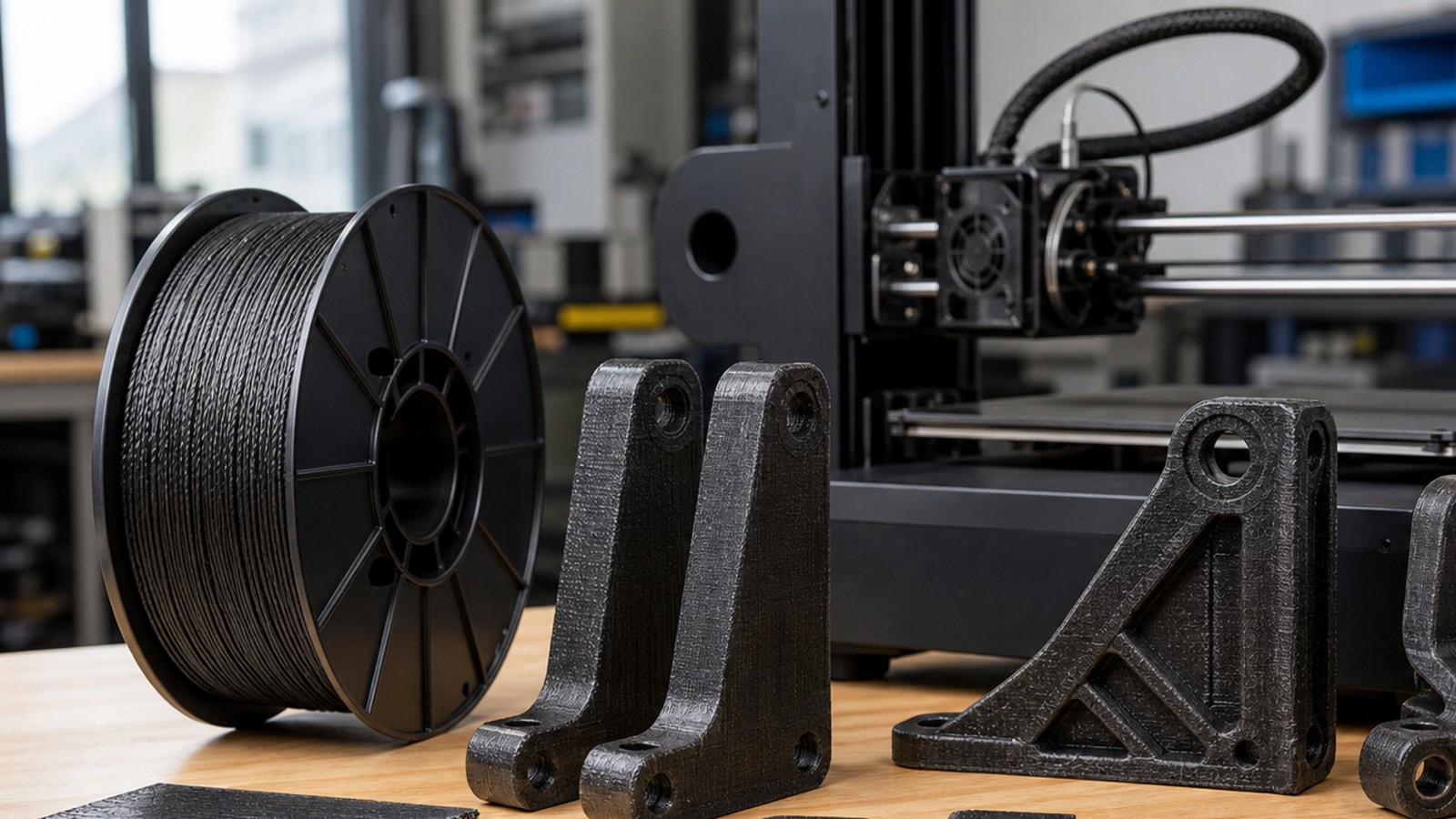
Continuous fiber 3D printing reinforces a polymer part with long strands of fiber placed inside the print. Markforged calls its version Continuous Fiber Fabrication, combining a plastic matrix with continuous carbon fiber, fiberglass, Kevlar, or other reinforcement options depending on the machine.
The goal is to create composite parts that are much stiffer and stronger than ordinary plastic prints in selected directions. It is most useful when the fiber path is designed around the load.
How It Works
A composite printer lays down a base thermoplastic, then a second system places continuous fiber into selected layers or regions. The slicer controls where reinforcement goes, how many fiber layers are used, and which areas remain plastic.
The part is not uniformly strong in every direction. Fiber orientation matters. A bracket loaded in bending needs reinforcement placed where it resists that bending, not randomly throughout the part.
Materials and Use Cases
Continuous carbon fiber is often used for stiff lightweight fixtures, brackets, tooling, robotic end-effectors, inspection gauges, and replacement metal-like parts where the load path is clear. Fiberglass or other fibers may fit cost, toughness, or electrical requirements better.
These parts are attractive when machining aluminum is slow or expensive and when ordinary FDM plastic is not stiff enough. They still need proper design and testing.
Strengths and Limits
The advantages are high stiffness-to-weight, fast tooling, useful strength in reinforced directions, and lighter parts than many metal alternatives. The limits are cost, printer ecosystem, fiber placement rules, surface finish, heat limits, and anisotropic behavior.
Continuous fiber printing is not magic metal replacement. It is a composite process. The fiber, matrix, orientation, and load path decide whether it works.
Beginner Takeaway
Continuous fiber printing is best for functional parts with clear loads, not decorative models. It belongs in engineering, manufacturing, robotics, tooling, and production-support workflows.
Before using it, identify the force direction, fixture requirements, fastener strategy, and test method. The strongest fiber part is the one reinforced with a purpose.
FAQ
Is continuous fiber 3D printing the same as carbon fiber filament?
No. Chopped carbon fiber filament contains short fibers mixed into plastic, while continuous fiber printing places long reinforcement strands inside the part.
Can continuous fiber prints replace metal?
Sometimes for fixtures or brackets, but only when load, heat, wear, and safety requirements are tested.
What is continuous fiber best for?
It is best for stiff lightweight functional parts, jigs, fixtures, brackets, and robotic tooling.